How Does a Motor Work? A Simple Guide to the Magic of Motion
Have you ever wondered what makes your toy car zoom across the floor? Or how a fan spins to keep you cool on a hot day? The answer is a little powerhouse called an electric motor. It might seem like magic, but I promise it’s not. It’s something even cooler: simple science! You see these motors everywhere but understanding them can feel tough. Many explanations use big, confusing words that leave you feeling more lost than when you started. But don’t worry. In this guide, I’m going to pull back the curtain and show you the secret, step-by-step. You’ll see exactly how electricity turns into motion, and it’s easier than you think.
Table of Contents
- What’s the Big Deal About an Electric Motor?
- What’s the Secret Force That Makes Motors Spin?
- What Are the Main Parts of a Motor?
- How Does a Simple DC Motor Actually Spin?
- Do All Motors Work the Same Way? (A Peek at AC Motors)
- Why Are There So Many Different Types of Motors?
- Where Do We Find Motors in Everyday Life?
- What Makes a Motor Good or Bad?
- What’s the Future for Electric Motors?
- The Main Idea to Remember
What’s the Big Deal About an Electric Motor?
So, what is an electric motor anyway? You see them in everything from your washing machine to giant industrial machinery. But it’s frustrating when you don’t know the basic motor concept behind these amazing gadgets. It feels like everyone else is in on a secret you haven’t heard.
Let’s fix that right now. At its heart, an electric motor is a special machine that does one amazing trick. It takes electrical energy (like the power from a battery or a wall socket) and turns it into motion. That’s it! This is called the electrical to mechanical energy conversion.
Think of it like this: you eat food (chemical energy) to get the power to run and play (mechanical energy). A motor “eats” electricity to get the power to spin and work. This simple idea, this motor working principle, is one of the most important inventions in history. It powers almost everything in our modern world.
What’s the Secret Force That Makes Motors Spin?
The secret behind every motor is a force called electromagnetism. That sounds like a big word, but the idea is simple. You already know about regular magnets, right? They have a north pole and a south pole. If you put two north poles together, they push each other away. This is repulsion. If you put a north pole and a south pole together, they pull toward each other. This is attraction.
An electromagnet is a temporary magnet made by flowing an electric current through a wire, usually one that is wrapped in a circle called a coil. When the electricity is on, the coil becomes a magnet. When you turn the electricity off, it stops being a magnet. This is the key!
Motors use this on-and-off magnet trick. They use the constant push and pull between magnets to create spinning motion. This magical push-pull is the simple version of what scientists call the Lorentz force. It’s the fundamental force that makes motors go.
What Are the Main Parts of a Motor?
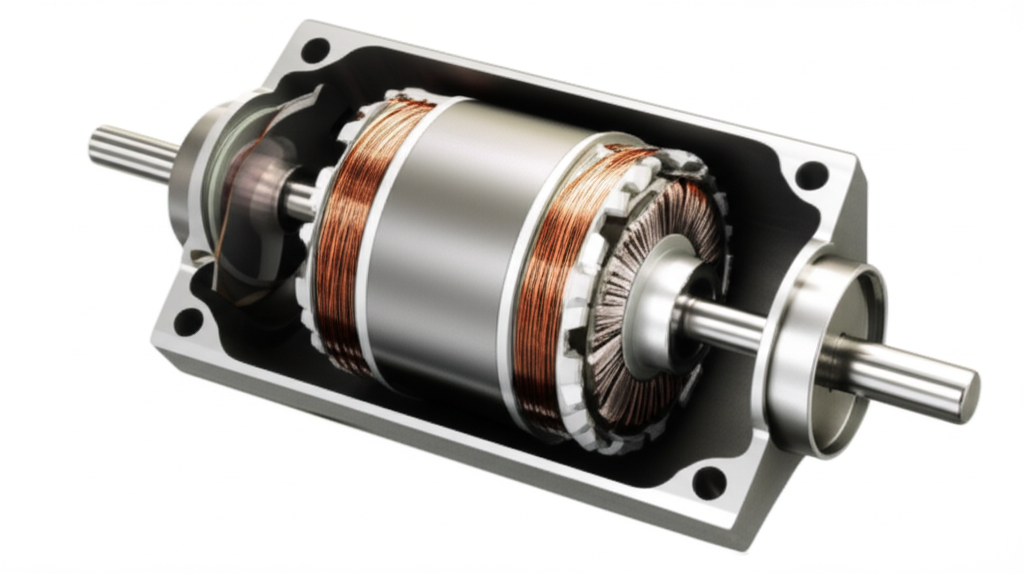
To understand how a motor works, you need to know its main players. Think of them like the parts of a team. Each one has a special job to do.
- The Stator: This is the outside part of the motor that stays still. Its name comes from the word “stationary.” The stator holds magnets. In some motors, they are permanent magnets. In others, they are electromagnets. The stator’s job is to create a powerful magnetic field that doesn’t move. The quality of the parts here, like the stator core lamination, is very important for the motor to run well.
- The Rotor: This is the part on the inside that spins, or “rotates.” This is the hero of our story! The rotor, also called an armature, has coils of wire wrapped around it called windings. When electricity flows through these windings, the rotor turns into an electromagnet and starts to spin.
- The Commutator and Brushes (in DC Motors): These two parts work together as the motor’s “brain.” The commutator is a special ring on the rotor’s shaft with gaps in it. The brushes are two small blocks that touch the commutator. They deliver electricity from the power supply to the rotor’s spinning coils. Their real genius is how they flip the direction of the electricity, which we’ll see next.
How Does a Simple DC Motor Actually Spin?
Okay, let’s put all the pieces together. Here is a step-by-step electric motor explanation for a simple DC motor, like one you’d find in a toy.
First, you connect a battery. The electricity flows through the brushes and into the commutator. From there, it goes into the wire coils on the rotor, turning the rotor into an electromagnet. Now you have two magnets: the stator on the outside and the new rotor electromagnet on the inside.
Second, the magnets start to push and pull on each other! The north pole of the rotor is pushed away by the north pole of the stator. At the same time, it’s pulled toward the stator’s south pole. This push and pull creates a twisting force called torque. This is what makes the rotor start to spin.
Third, here comes the clever part. Just as the rotor’s poles are about to line up with the stator’s poles, the brushes cross the little gaps on the commutator. For a split second, they switch which part of the coil they are touching. This flips the direction of the electric current in the rotor. This flip also instantly reverses the rotor’s magnetic poles! The north pole becomes a south pole, and the south pole becomes a north pole.
Finally, the part of the rotor that was just being pulled is now being pushed away, and vice-versa. This repulsion attraction motor cycle keeps happening over and over again, very fast. The rotor never gets to “rest.” It’s always being pushed and pulled, which is what creates continuous, smooth motor rotation.
Do All Motors Work the Same Way? (A Peek at AC Motors)
While the basic idea of using magnets is the same, not all motors work exactly like the DC motor we just described. The other big family is the AC motor. The biggest difference between AC DC motor types is the kind of electricity they use.
DC, or Direct Current, is what you get from a battery. The electricity flows in one steady direction. AC, or Alternating Current, is what comes out of the outlets in your house. This electricity quickly switches its direction back and forth, like a wave. The famous inventor Nikola Tesla was a pioneer of AC power.
An AC induction motor, the most common type of motor in the world, uses this wave-like power in a brilliant way. The AC current flowing through the stator’s coils creates a rotating magnetic field. You can imagine it as an invisible magnet that is constantly spinning around inside the stator. This spinning field then pulls the rotor along with it, making it spin too. It’s like dangling a carrot in front of a rabbit to make it run. It’s a simple, strong design, which is why you’ll find it in a fan motor or a pump motor. You can learn more about the fundamental motor principle to see how different designs achieve motion.
Why Are There So Many Different Types of Motors?
If you look around, you’ll see there are many types of electric motors. Why so many? Because different jobs need different tools! You wouldn’t use a giant crane to lift a pencil, right? It’s the same with motors.
- Brushless DC (BLDC) Motors: These are smart, efficient motors. They use electronics instead of brushes to switch the electricity. This makes them last longer and waste less energy. You find them in computers, electric cars, and high-tech drones. The design of a bldc stator core is key to making these motors so powerful and efficient.
- Stepper Motors: These motors don’t just spin freely. They move in tiny, exact steps. This precision is perfect for things like 3D printers and robots, where you need perfect control.
- Servo Motors: A servo motor is designed to move to a specific position and hold it there. They are used in radio-controlled airplanes to move the flaps on the wings or in robotics for moving an arm to a precise spot.
Here is a quick look at where different motors are used:
| Motor Type | Common Applications | Key Feature |
|---|---|---|
| Brushed DC Motor | Toys, Small Appliances | Simple and cheap |
| AC Induction Motor | Washing Machines, Fans, Industrial Pumps | Robust and reliable |
| Brushless DC Motor | Drones, EVs, Computer Fans | High efficiency and long life |
| Stepper Motor | 3D Printers, Scanners | Precise step-by-step motion |
| Servo Motor | Robotics, RC Airplanes | Precise position control |
Where Do We Find Motors in Everyday Life?
It’s easy to think that motors are just hidden away in factories. But that’s a huge mistake! You are probably never more than a few feet away from an electric motor. Once you start looking, you’ll see them everywhere.
Think about your morning. A motor in the city’s water plant pumped water to your house. A motor in your refrigerator keeps your milk cold. A motor in your blender whips up your smoothie. When your phone vibrates, that’s a tiny micro motor spinning an off-balance weight.
From the compressor motor in an air conditioner to the traction motor in a train, these devices are the invisible workhorses of our world. The rise of electric vehicle motor technology is putting powerful, efficient motors in our cars. We have so many modern conveniences because of the amazing variety of motor application in our daily lives.
What Makes a Motor Good or Bad?
Have you ever used a tool that got really hot and didn’t seem very powerful? It was probably wasting a lot of energy. This is a common motor problem. The difference between a great motor and a bad one often comes down to motor efficiency and the quality of its insides.
A motor’s job is to turn electricity into motion. But sometimes, a lot of that electricity gets wasted as heat. This is where the core of the motor—the metal parts inside the stator and rotor—becomes super important. These cores are not solid blocks of metal. They are made of very thin sheets of special steel stacked together. These are called laminations.
Making the core from thin, insulated sheets, like the silicon steel laminations made by experts like Sino Lamination, helps stop wasteful electric currents from swirling inside the metal. This keeps the motor from getting too hot and wasting power. A motor built with high-quality motor core laminations runs cooler, uses less electricity, and lasts much longer. It’s the secret to turning more power into useful work.
What’s the Future for Electric Motors?
The story of the motor is far from over! Engineers are working on the future of motor technology every day. They are making motors that are smaller, more powerful, and smarter than ever before.
Researchers are exploring nanotechnology motors that are too small to see with the naked eye. Imagine tiny medical robots that could travel through your body to fix problems! We’re also seeing new designs like direct drive motor technology, which connects the motor directly to the job it’s doing, making machines simpler and more efficient.
But the biggest focus is on saving energy. As the table below from the International Energy Agency shows, motors use a huge amount of the world’s power. By making them even more efficient, we can save a massive amount of energy and help protect our planet.
| Category | Data/Statistic |
|---|---|
| Energy Use | Motors consume nearly 50% of the world’s electricity. |
| EV Growth | The electric vehicle market is expected to reach tens of millions of cars per year. |
| Market Size | The global electric motor market is worth over $100 billion. |
The Main Idea to Remember
So, we’ve taken a deep dive into the world of motors. It can seem like a lot, but the main idea is incredibly simple. You don’t need to be an expert in electrical engineering to get it. The whole “magic” of an electric motor boils down to one powerful concept: using electricity to create temporary magnets and then using the basic push-and-pull force of those magnets to create endless spinning motion.
From the first simple motors built by pioneers like Michael Faraday to the super-advanced motors in today’s electric cars, this core principle hasn’t changed. It’s a beautiful and clever idea that has truly changed the world. Now, you’re in on the secret.
Here are the most important things to remember:
- The Main Job: A motor’s purpose is to turn electricity into physical motion.
- The Secret Force: This is done using electromagnetism—the magnetic force created when electricity flows through a wire.
- The Key Parts: The main parts are the stationary stator (outside) and the spinning rotor (inside).
- The Spin Cycle: Motors work by constantly pushing and pulling the rotor’s electromagnets with the stator’s magnets, creating torque.
- Quality Matters: The efficiency and power of a motor depend heavily on the quality of its internal components, like the core laminations.