What Are Brushes in a Motor? The Essential Guide to How They Work & Why They Matter
Every engineer, product designer, and maintenance manager has faced a similar scenario. A reliable power tool suddenly loses torque and starts spitting sparks. A critical component in an assembly line begins to operate intermittently. Or a prototype for a new home appliance fails without warning. More often than not, the culprit is one of the smallest, simplest, and most overlooked components in the system: the motor brush.
If you’ve ever found yourself troubleshooting a failing motor or weighing the design trade-offs between different motor technologies, you understand that these small carbon blocks are more than just wear items—they are the heart of the commutation system in a vast number of electric motors. Understanding their function, materials, and failure modes isn’t just academic; it’s a critical piece of engineering knowledge that empowers better design, smarter purchasing, and more effective maintenance.
You’re in the right place. This guide will break down the engineering principles behind motor brushes, moving from the fundamental “what” and “how” to the practical applications and maintenance insights that matter in the real world.
What We’ll Cover
- The Core Function: How motor brushes serve as the essential electrical bridge in brushed motors.
- Anatomy of a Motor Brush: A look at the materials and components that make them work.
- Common Applications: Where you’ll find brushed motors in everyday and industrial technology.
- Wear, Troubleshooting, and Maintenance: Identifying the signs of failing brushes and what to do about them.
- Brushed vs. Brushless Motors: A clear comparison to help you understand the key differences and why both technologies persist.
- Your Engineering Takeaway: Key points to remember for your next project or repair.
The Core Function: How Motor Brushes Power Rotation
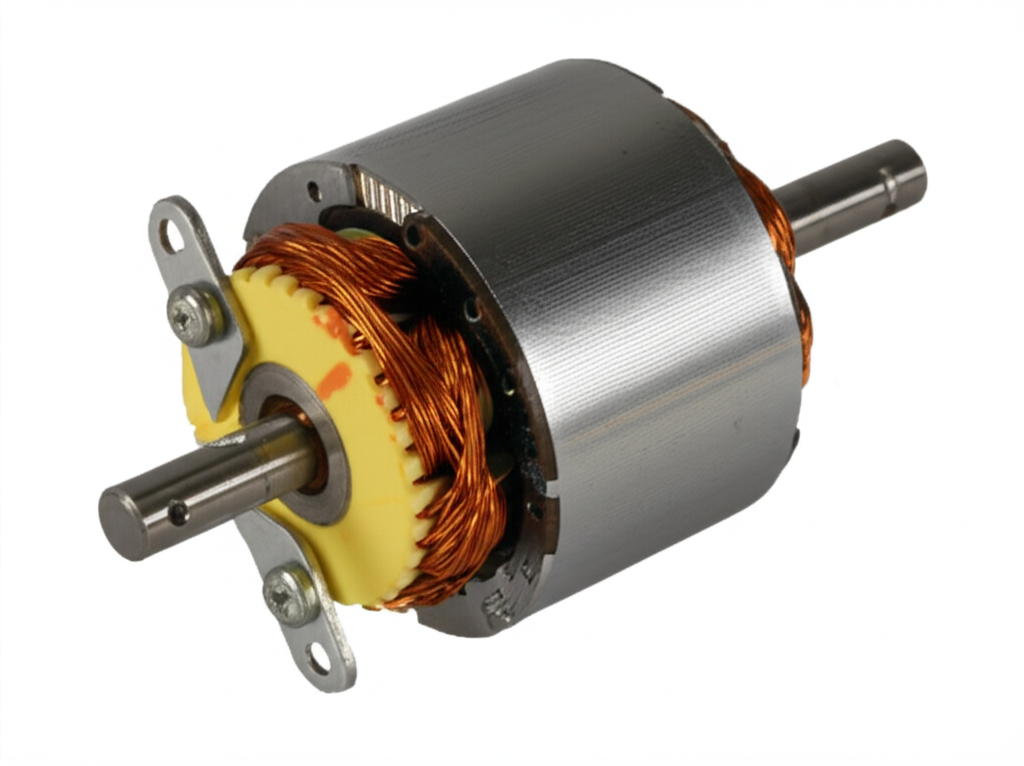
At its heart, a brushed DC motor operates on a principle of controlled electromagnetism. To make the motor’s shaft spin continuously, you have to constantly change the direction of the magnetic field in the rotating part of the motor, known as the rotor or armature. But how do you get electricity from a stationary power source to windings that are spinning at thousands of RPM?
This is the precise problem that motor brushes solve.
Think of a motor brush as a sophisticated electrical bridge. Its primary job is to maintain a sliding physical and electrical contact with the commutator—a segmented copper cylinder at the end of the rotor.
Here’s a step-by-step breakdown of this elegant process:
Without brushes and a commutator, the rotor would simply turn until its magnetic poles aligned with the stator’s poles and then stop—it wouldn’t be a motor at all. The brushes are the unsung heroes that enable the constant, dynamic switching required for continuous mechanical motion. Of course, while brushes are critical for electrical transfer, the ultimate performance also depends on the magnetic circuit. The design of the stator core lamination in the stationary part of the motor is just as crucial for focusing the magnetic flux and maximizing efficiency.
Anatomy of a Motor Brush: Materials and Structure
While they may look like simple blocks of carbon, motor brushes are engineered components designed to balance conductivity, durability, and low friction. The choice of material and construction is a critical engineering decision that directly impacts the motor’s performance, lifespan, and operational characteristics.
Common Brush Materials
The material isn’t just chosen at random; it’s selected based on the motor’s intended current, speed, and operating environment.
- Carbon-Graphite: This is the workhorse of the motor brush world. It’s the most common type for a reason. Graphite provides excellent self-lubricating properties, which is crucial for reducing friction and wear against the spinning copper commutator. Carbon provides the necessary hardness and resistance to wear. This blend offers a fantastic balance of good conductivity, low friction, and long life for general-purpose applications.
- Electro-Graphite: Created by baking carbon at extremely high temperatures, this material is purer and has a more ordered crystalline structure. This gives it a higher current-carrying capacity and superior performance in high-temperature, high-speed applications.
- Metal-Graphite (e.g., Copper-Graphite): For applications that require very low electrical resistance and high current density, graphite is mixed with fine metal powders like copper or silver. You’ll find these in low-voltage, high-current motors such as automotive starters or forklift motors. The trade-off is that the metal content makes them more abrasive, leading to faster wear on the commutator itself.
- Resin-Bonded Graphite: In some smaller, low-load motors, graphite powder is mixed with a resin binder and cured. These are often less expensive to produce but are suitable only for specific, less demanding applications.
Physical Components of the Brush Assembly
A brush is more than just the carbon block. It’s part of a system designed to ensure reliable contact.
- Brush Body: The main block of conductive material that contacts the commutator. Its shape and size are specific to the motor design.
- Pigtail (or Shunt Wire): A highly flexible, braided copper wire embedded into the brush body. Its job is to carry the current from the terminal to the brush body without relying on the spring, ensuring a low-resistance path.
- Terminal/Connector: The metal clip or ring at the end of the pigtail that connects to the motor’s power leads.
- Brush Spring: This often-overlooked component is vital. It provides a constant, engineered amount of pressure to keep the brush in firm contact with the commutator, even as the brush wears down. Too little pressure causes “brush bounce” and excessive arcing, while too much pressure causes rapid mechanical wear.
- Brush Holder: A housing, typically made of metal or high-temperature plastic, that holds the brush and spring in the correct position and alignment relative to the commutator.
Where You’ll Find Them: Common Applications of Brushed Motors
Despite the rise of brushless technology, brushed DC motors and universal motors (which can run on AC or DC) remain incredibly prevalent due to their simplicity, low manufacturing cost, and excellent torque characteristics. You interact with them every day.
- Power Tools: Your cordless drill, circular saw, angle grinder, and router likely use brushed motors. They provide the high starting torque needed to get the job done, and their simple speed control is ideal for these applications.
- Household Appliances: Many vacuum cleaners, blenders, mixers, and sewing machines use universal motors with brushes. Their ability to deliver high power in a compact, lightweight package makes them perfect for these devices.
- Automotive Systems: While modern cars increasingly use brushless motors, brushed motors are still common in starter motors, power window actuators, windshield wipers, and HVAC blower fans. Their robustness and low cost are major advantages here.
- Hobby and Small Motors: From remote-controlled cars and drones to small robotics and children’s toys, the simple two-wire control and inexpensive nature of brushed DC motors make them a go-to choice.
The Lifespan of a Brush: Wear, Troubleshooting, and Maintenance
The single biggest drawback of a brushed motor is that the brushes are a wear component. By their very design—maintaining sliding contact with a spinning surface—they are destined to erode over time. This wear is caused by a combination of mechanical friction and electrical arcing.
Understanding the signs of worn motor brushes is key to effective troubleshooting and maintenance. If you’re seeing any of these symptoms, your brushes should be the first thing you inspect.
Signs of Worn Motor Brushes
Maintenance and Replacement
For any equipment that uses a brushed motor, inspecting the brushes should be part of a regular preventative maintenance schedule. Replacement is often a straightforward process:
- Inspect Regularly: Check the brush length against the manufacturer’s wear line indicator.
- Replace in Pairs: Always replace both (or all) brushes in a motor at the same time. Replacing only one can lead to uneven wear and poor performance.
- Use the Correct Grade: It’s crucial to use the exact replacement brush specified by the motor manufacturer. Using the wrong material grade can lead to rapid brush wear or, even worse, damage the commutator, which is a much more expensive repair.
- Clean the Commutator: When replacing brushes, inspect the commutator for dirt and carbon buildup. Clean it gently with a non-conductive, residue-free cleaner and a soft cloth to ensure a good contact surface for the new brushes.
Brushed vs. Brushless Motors: A Modern Comparison
No discussion of motor brushes is complete without addressing their modern counterpart: the brushless DC (BLDC) motor. The rise of affordable electronics has made brushless technology increasingly common, but that doesn’t make brushed motors obsolete. Understanding the difference helps you appreciate why engineers choose one over the other.
The fundamental difference is in how they achieve commutation.
- Brushed Motor: Uses mechanical commutation (physical brushes and a commutator).
- Brushless Motor: Uses electronic commutation (an electronic controller and sensors or algorithms to switch the current in the stator windings).
In a brushless motor, the roles are reversed: the permanent magnets are on the rotor, and the windings are on the stator. Since the windings don’t move, there’s no need for brushes to transfer power. An external controller energizes the stator windings in a precise sequence to make the rotor spin. The engineering behind both types is fascinating, with the design of motor core laminations being a critical factor in performance for both.
Here’s a head-to-head comparison:
| Feature | Brushed Motor | Brushless Motor |
|---|---|---|
| Maintenance | Higher (brushes wear out and need replacement) | Virtually none (no wear components) |
| Lifespan | Shorter (limited by brush and commutator life) | Significantly longer (limited by bearing life) |
| Efficiency | Lower (75-80%) due to friction and arcing losses | Higher (85-95%) due to no brush-related losses |
| Noise | Noisier due to brush friction and sparking | Much quieter operation |
| Cost | Lower initial manufacturing cost, simple control | Higher initial cost due to complex electronic controller |
| EMI/Sparks | Generates electromagnetic interference from arcing | No sparking, much lower EMI |
So, Why Do Brushed Motors Persist?
The answer is simple: cost and simplicity. For countless applications where extreme longevity isn’t the primary concern and a lower price point is critical, a brushed motor is still the most economical and robust solution. The control electronics are far simpler, often just requiring a direct DC voltage. In contrast, every brushless motor requires a sophisticated electronic speed controller (ESC) to operate, adding cost and complexity. The quality of a bldc stator core is paramount for efficiency in these advanced designs.
Your Engineering Takeaway
Motor brushes are not just simple blocks of carbon; they are a clever and cost-effective engineering solution to a complex problem. For over a century, they have been the key that unlocks continuous rotational motion in a huge variety of electric motors.
Here are the essential points to remember:
- The Critical Bridge: The primary function of motor brushes is to transfer electrical current from the stationary stator to the rotating rotor via the commutator.
- Commutation is Key: This transfer and the switching action of the commutator are what create continuous, unidirectional torque.
- Material Matters: The choice of brush material (from carbon-graphite to metal-graphite) is a trade-off between conductivity, durability, and cost, tailored to the motor’s specific application. The performance of the underlying magnetic core, built from high-quality rotor core lamination, is equally vital.
- Wear is Inevitable: Brushes are designed to be a consumable component. Recognizing the signs of wear—like excessive sparking and power loss—is a fundamental troubleshooting skill.
- Brushed Isn’t Obsolete: Despite the many advantages of brushless technology, the simplicity, low cost, and high torque of brushed motors ensure they will remain relevant in countless applications for years to come.
By understanding these small but mighty components, you are better equipped to design robust products, diagnose equipment failures, and make informed decisions about the technology that powers our world.