What Do Electric Motors Do? The Essential Guide to How They Work and Their Impact
Every product designer and engineer, at some point, confronts a fundamental challenge: converting a concept into motion. Whether you’re designing a high-performance electric vehicle, a life-saving medical device, or an automated industrial system, the question of “how” to create that movement is paramount. If you’ve ever found yourself deep in a project, needing a reliable, efficient, and controllable source of mechanical power, you’re in the right place. The answer, more often than not, lies within an electric motor.
Electric motors are the unsung heroes of our modern world. They are the invisible workhorses tucked away inside the devices we rely on daily and the massive machinery that powers our global economy. But what, exactly, do they do? The short answer is simple: they convert electrical energy into useful mechanical motion.
However, understanding this core function is just the beginning. To truly leverage their power in your designs, it’s crucial to grasp the principles behind this conversion, the key components that make it possible, and the vast landscape of applications they’ve revolutionized. This guide will demystify the electric motor, transforming it from a “black box” component into a powerful tool you can specify and implement with confidence.
What We’ll Cover
- The Core Function: From Electricity to Movement
- How Electric Motors Work: The Principle of Electromagnetism
- Key Components of an Electric Motor
- Types of Electric Motors and Their Mechanisms
- Where Do Electric Motors Do Their Work? (Real-World Applications)
- The Importance and Benefits of Electric Motors
- The Future of Electric Motors
The Core Function: From Electricity to Movement
At its very heart, the purpose of an electric motor is to perform one of the most fundamental transformations in physics and engineering: electromechanical conversion.
Think of it like a translator. It takes one language—the flow of electrons (electrical energy)—and translates it into another: the language of physical force and motion (mechanical energy). This mechanical output usually comes in the form of rotational motion, where a central shaft spins. This spinning shaft can then be connected to gears, wheels, fans, pumps, or any number of other components to do work.
The “Why” of Energy Conversion
Why is this conversion so vital? Because while electricity is an incredibly efficient way to transmit and distribute power over long distances, it can’t, by itself, move a physical object. You can’t push a conveyor belt or spin a drill bit with raw electrical current. You need a device to bridge that gap. The electric motor is that bridge. It’s the critical link that turns the potential of an electrical grid or a battery into the kinetic reality of a moving car, a cooling fan, or a robotic arm. This process—turning electrical energy into mechanical energy—is the foundational function that underpins nearly every piece of modern technology that moves.
How Electric Motors Work: The Principle of Electromagnetism
The “magic” behind an electric motor isn’t magic at all; it’s a brilliant application of a fundamental physical principle: electromagnetism. The concept is elegantly simple: when an electric current flows through a wire, it generates a magnetic field around that wire.
Imagine you have two simple bar magnets. If you bring their north poles together, they repel each other. If you bring a north and a south pole together, they attract. This pushing and pulling is the Lorentz Force in action. Now, what if one of those magnets wasn’t a permanent magnet but an electromagnet—a coil of wire that only becomes a magnet when electricity is flowing through it?
You’ve just discovered the basic principle of an electric motor.
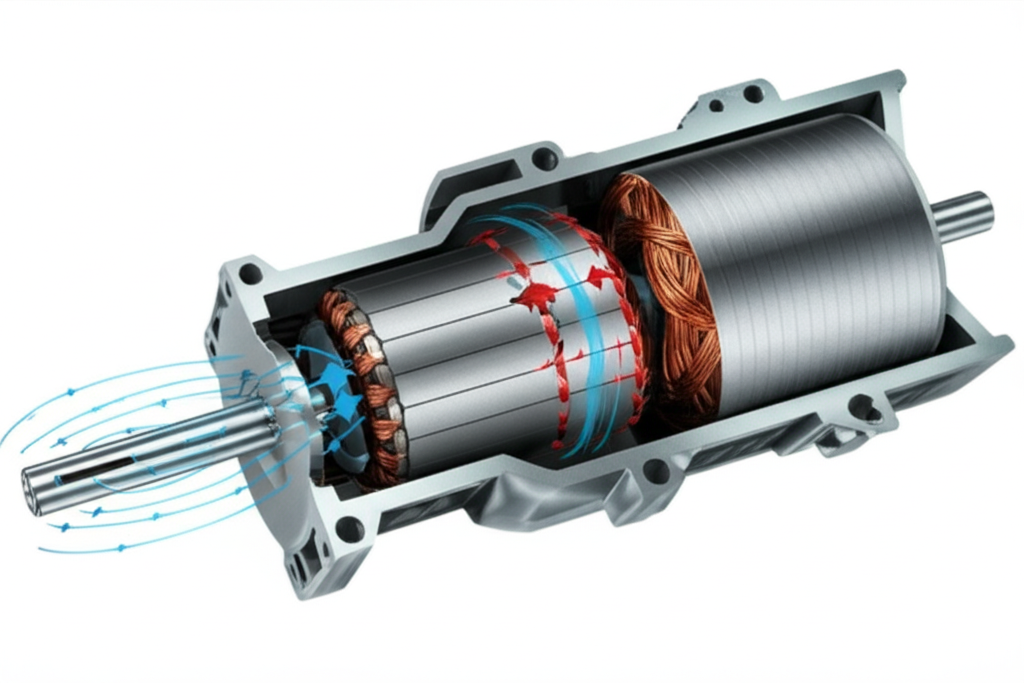
Inside a motor, you have a stationary part and a rotating part, both of which have magnetic fields. By precisely controlling the flow of electricity into coils of wire, the motor creates powerful electromagnets that are constantly pushing and pulling against other magnets (either permanent magnets or other electromagnets).
This constant, controlled dance of magnetic attraction and repulsion is what makes an electric motor spin, converting electrical signals into thousands of revolutions per minute (RPM).
Key Components of an Electric Motor
While designs vary enormously, most common rotational motors share a few key components. Understanding what they are and what they do is essential for any engineer.
Stator: The Stationary Powerhouse
The stator, as its name implies, is the stationary part of the motor. It’s typically the outer housing and contains a set of electromagnets, formed by running current through coils of wire (windings) wrapped around a laminated iron core. Its job is to generate a stationary or rotating magnetic field that the rotor will interact with. The quality of the stator core lamination is critical, as it concentrates the magnetic field and minimizes energy losses.
Rotor: The Heart of Rotation
The rotor is the moving part that spins. It’s mounted on a shaft, which extends outside the motor to deliver the mechanical power. Like the stator, the rotor also has magnets. These can be permanent magnets or, more commonly in industrial applications, electromagnets created by windings. The interaction between the stator’s magnetic field and the rotor’s magnetic field is what generates the torque to make it spin. The construction of the rotor core lamination is crucial for efficiency and performance, especially in high-speed applications.
Windings (Coils): The Source of Magnetism
These are the coils of copper wire wrapped around the soft iron cores in both the stator and rotor. When electrical current passes through them, they behave like magnets. The number of windings, the thickness of the wire, and how they are arranged determine the motor’s voltage requirements, power output, and speed characteristics.
Commutator and Brushes (Primarily in Brushed DC Motors)
In many DC motors, these components work together as a clever mechanical switch. The commutator is a segmented metal ring on the rotor, and the brushes are stationary carbon blocks that press against it. As the rotor spins, the brushes make contact with different segments of the commutator, reversing the direction of the current in the rotor windings. This polarity flip is what keeps the torque pushing in the same direction, ensuring continuous rotation. However, this mechanical contact creates friction and wear, which is why brushless designs have become increasingly popular.
Shaft and Bearings
The shaft is the central rod that the rotor is mounted on. It’s the part that transfers the rotational power out of the motor to the load. The shaft is held in place by bearings, which are crucial for reducing friction and allowing the rotor to spin smoothly and efficiently for thousands of hours.
Types of Electric Motors and Their Mechanisms
The world of electric motors is incredibly diverse, with designs optimized for countless different tasks. They are broadly categorized by their input power source: Alternating Current (AC) or Direct Current (DC).
AC Motors (Alternating Current)
AC motors are powered by the standard electrical current available from the grid. They are the workhorses of industry due to their robustness and simplicity.
- Induction Motors: This is the most common type of motor used in industrial applications, from pumps and fans to conveyor belts. Their genius lies in their simplicity. The stator’s rotating magnetic field induces a current (and thus a magnetic field) in the rotor without any direct electrical connection. This elegant principle, pioneered by Nikola Tesla, makes them reliable, inexpensive, and low-maintenance.
- Synchronous Motors: In a synchronous motor, the rotor rotates at the exact same speed (in sync) as the stator’s magnetic field. This requires the rotor to have its own source of magnetism, often from permanent magnets or a DC current. They are used in applications requiring precise speed control, like clocks, timers, and high-precision industrial machinery.
DC Motors (Direct Current)
DC motors are powered by a constant voltage source, like a battery or a DC power supply. They are prevalent in portable electronics, automotive applications, and robotics.
- Brushed DC Motors: This is the classic motor design, using brushes and a commutator to switch the current direction in the rotor. They are simple to control and inexpensive, but the brushes wear down over time, requiring maintenance and limiting their lifespan and top speed.
- Brushless DC (BLDC) Motors: BLDC motors are a significant technological leap. They flip the traditional design inside out: the permanent magnets are on the rotor, and the electromagnets are on the stator. Instead of mechanical brushes, an electronic controller switches the current in the stator windings at the right time to keep the rotor spinning. This eliminates friction and wear, resulting in higher efficiency, longer lifespan, quieter operation, and better speed control. The design of the bldc stator core is particularly important for maximizing the performance of these advanced motors. They are now dominant in drones, computer fans, cordless power tools, and electric vehicles.
Specialized Motors
Beyond these main categories, there are many specialized motors designed for specific tasks:
- Servo Motors: These are closed-loop systems that include a motor, a position sensor, and a controller. They allow for incredibly precise control over angular position, velocity, and acceleration, making them essential for robotics and CNC machinery.
- Stepper Motors: These motors move in discrete, precise steps. They are excellent for applications where exact positioning is more important than speed, such as in 3D printers, scanners, and camera lenses.
- Linear Motors: A linear motor is essentially an electric motor that has been “unrolled.” Instead of producing torque (rotation), it produces a linear force along its length. They are used in high-speed trains (maglev), roller coasters, and precision positioning systems.
Where Do Electric Motors Do Their Work? (Real-World Applications)
The impact of electric motors is staggering. They are responsible for an estimated 45-50% of all global electricity consumption, a testament to their pervasive role in our world. Look around, and you’ll find them everywhere.
- Transportation: The most visible modern application is in Electric Vehicles (EVs). An EV motor, which boasts an efficiency of 85-95% (compared to 20-40% for an internal combustion engine), provides instant torque for rapid acceleration and is the core of the electric transportation revolution. They are also in trains, e-bikes, scooters, and even the positioning systems on ships.
- Home Appliances: Your home is a museum of electric motors. They are in the compressor of your refrigerator, the drum of your washing machine, the blades of your blender, the pump of your dishwasher, and the brush in your vacuum cleaner.
- Industrial Machinery: Industry would grind to a halt without electric motors. They power the pumps that move water, the fans and compressors that manage air, the conveyor belts that move products, the robotic arms that assemble electronics, and the machine tools that shape metal. In fact, industrial applications account for over 70% of the energy consumed by motors worldwide.
- Power Tools and Equipment: From cordless drills and circular saws to lawnmowers and leaf blowers, compact and powerful electric motors have transformed manual labor.
- HVAC Systems: The fans that circulate air in your heating and air conditioning systems are driven by electric motors, as are the compressors in the AC units themselves.
- Medical and Scientific Devices: Precision motors like servos and steppers are critical in MRI scanners, blood centrifuges, surgical robots, and lab automation equipment where accuracy can be a matter of life and death.
The Importance and Benefits of Electric Motors
Specifying an electric motor for a project isn’t just about making something move; it’s about leveraging a host of engineering and business benefits that have made them the prime mover of choice.
1. Unmatched Efficiency
Electric motors are exceptionally good at their job. High-efficiency models, especially those built with superior motor core laminations, can convert over 95% of the incoming electrical energy into useful mechanical work. This is a stark contrast to internal combustion engines, which waste a majority of their energy as heat. This efficiency translates directly into lower energy consumption, reduced operating costs, and less environmental impact. For example, upgrading an old industrial motor from a standard efficiency class (IE1) to a super-premium one (IE4) can reduce its energy losses by 20-30%, often providing a return on investment in just a few years.
2. Reliability and Durability
With fewer moving parts than mechanical engines, electric motors—especially induction and brushless types—are incredibly reliable. They can operate for tens of thousands of hours with only minimal maintenance (like bearing lubrication), leading to less downtime and a lower total cost of ownership.
3. Precision and Control
Modern electric motors, when paired with electronic controllers like a Variable Frequency Drive (VFD), offer an unparalleled level of control over speed, torque, and position. This precision enables the complex automation found in robotics, the smooth ride of an elevator, and the consistent output of a manufacturing line.
4. Positive Environmental Impact
In an era focused on sustainability, electric motors are a key technology. In transportation, they eliminate tailpipe emissions. In industry, their high efficiency is a cornerstone of energy conservation efforts. A case study from a textile factory in India showed that replacing 50 old motors with modern high-efficiency models cut their annual electricity bill by 15% and reduced CO2 emissions by 200 tons.
5. Enablers of Innovation
From tiny motors in haptic feedback systems to massive motors driving mining equipment, their scalability, reliability, and controllability make them the foundation for countless technological innovations. They are compact, quiet, and produce no localized emissions, allowing them to be integrated into designs and environments where other power sources would be impractical.
The Future of Electric Motors
The evolution of the electric motor is far from over. The future promises even more efficient, powerful, and intelligent designs.
- Advanced Materials: Research into new magnetic materials and superconducting wires aims to reduce size and weight while increasing power density, which is critical for aerospace and automotive applications.
- Smart Integration: The integration of motors with IoT (Internet of Things) sensors and AI is leading to “smart motors.” These motors can monitor their own performance, predict maintenance needs before a failure occurs, and optimize their energy consumption in real-time.
- Sustainability and Design: There is a growing focus on designing motors with sustainability in mind, using more recyclable materials and designing for easier disassembly and repair to support a circular economy.
Conclusion: Powering Progress, One Rotation at a Time
So, what do electric motors do? They do more than just spin. They take the invisible power of electricity and turn it into the tangible motion that defines our modern existence. They are the quiet, reliable heart of industry, the muscle behind our appliances, and the driving force of our transition to a more sustainable future.
For the engineer, designer, or manager, understanding the electric motor is understanding one of the most powerful and versatile tools available. From the fundamental principle of electromagnetism to the tangible benefits of efficiency and reliability, they represent a century of innovation that continues to evolve. By converting electrical potential into mechanical reality, they power progress, one rotation at a time.