What Does a Servo Motor Do? Unlocking Precision Motion Control
In the world of modern engineering, from sprawling automated factories to delicate medical instruments, the need for precise, controlled movement is paramount. You can’t just throw an on/off switch and hope for the best. You need motors that can start, stop, turn, and hold position with pinpoint accuracy. This is where the servo motor shines, acting as the muscle behind countless high-tech applications. If you’ve ever wondered how a robotic arm can move with such fluid grace or how a CNC machine carves intricate designs, you’ve witnessed the power of servo motors.
In This Article
- What Exactly Is a Servo Motor?
- How Does a Servo Motor Work? The Closed-Loop Advantage Explained
- Core Functions & Capabilities: What Can Servo Motors Achieve?
- Why Choose a Servo Motor? Key Advantages
- Where Do Servo Motors Make a Difference? Real-World Applications
- Types of Servo Motors
- Servo Motor vs. Stepper Motor: A Fundamental Distinction
- Conclusion: The Indispensable Role of Servo Motors in Tomorrow’s Technology
What Exactly is a Servo Motor?
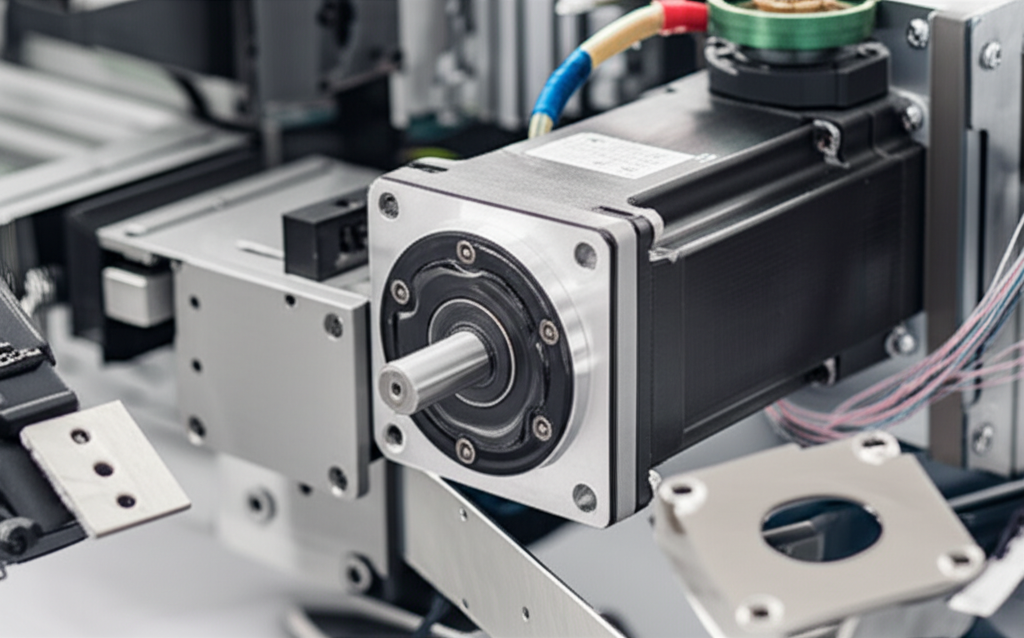
At its heart, a servo motor is a rotary or linear actuator that allows for precise control of angular or linear position, velocity, and acceleration. Think of it not just as a motor that spins, but as a complete system designed for high-performance motion control.
The defining characteristic that sets a servo motor apart from a standard DC or AC motor is its use of a closed-loop feedback system. A regular motor, when you apply power, just runs. It doesn’t inherently know its own speed or position. A servo motor, however, is far more intelligent. It’s part of a system that constantly checks its own position and makes adjustments to ensure it’s exactly where it needs to be. This is like the difference between blindly throwing a ball and having a sophisticated guidance system that steers the ball to its target in real-time.
How Does a Servo Motor Work? (The Closed-Loop Advantage Explained)
To truly understand what a servo motor does, we need to look under the hood at its operating principle: the closed-loop system. This system is a continuous cycle of communication and correction.
The Core Principle: Constant Feedback for Unparalleled Accuracy
Imagine you’re trying to park your car perfectly parallel to the curb. You look in your mirrors (feedback), see you’re too far away, and turn the steering wheel (the command) to adjust. You keep checking and adjusting until the car is in the perfect spot. A servo motor does this exact same thing, but thousands of times per second.
This process involves several key components working together:
Essential Components of a Servo System:
Step-by-Step Operation:
Let’s walk through how these components work together to achieve precise positioning:
This constant feedback and correction loop is what gives a servo motor its incredible accuracy and responsiveness.
Core Functions & Capabilities: What Can Servo Motors Achieve?
Because of their sophisticated control system, servo motors excel at tasks that other motors simply can’t handle. Their primary functions include:
- Precise Position Control: This is their most famous trait. A servo can be commanded to move to a specific angle and hold that position with extreme accuracy and stability. This is crucial for applications like robotic arms that need to place components with pinpoint precision.
- Accurate Velocity Control: Servos can maintain a very steady speed, regardless of changes in the load. For example, in a conveyor system, a servo can ensure the belt moves at a constant rate, which is vital for synchronization and quality control.
- Dynamic Torque Control: A servo can apply a specific, controlled amount of twisting force (torque). This is essential in applications like bottle capping machines, where the cap needs to be tightened just enough—not too loose, not too tight.
- Rapid Acceleration & Deceleration: Servos can start and stop incredibly quickly without overshooting their target position. This high dynamic performance is critical in fast-paced automation, like pick-and-place machines that move thousands of parts per hour.
- High Repeatability: They can perform the exact same motion over and over again with minimal deviation. This consistency is a cornerstone of modern manufacturing and quality assurance.
- Smooth Motion at Low Speeds: Unlike some other motor types that can “cog” or stutter at very low speeds, servos can provide smooth, controlled motion across their entire speed range.
Why Choose a Servo Motor? Key Advantages
So, when would an engineer choose a servo motor over a simpler, cheaper alternative? The answer lies in its distinct advantages:
- Unmatched Precision and Accuracy: The closed-loop feedback system is the game-changer. It actively corrects for errors, ensuring the motor is always where it’s supposed to be. This is a level of accuracy that open-loop systems like stepper motors cannot guarantee.
- High Dynamic Performance: If your application requires rapid changes in speed and direction, a servo is the way to go. They have a high torque-to-inertia ratio, meaning they can accelerate and decelerate very quickly.
- High Torque at High Speeds: Many motors lose torque as they speed up. Servos, especially brushless DC types, can maintain a high percentage of their rated torque even at high rotational speeds, making them powerful and efficient across a wide operating range.
- Energy Efficiency: A servo motor only draws the current it needs to hold its position or move a load. If it’s stationary and under no load, it consumes very little power. In contrast, a stepper motor consumes full power just to hold its position, which can lead to significant heat generation and wasted energy.
- Quiet Operation: Without the step-by-step movement of a stepper motor, servos (especially brushless ones) run much more smoothly and quietly, which is a bonus in many environments.
Where Do Servo Motors Make a Difference? Real-World Applications
You’ll find servo motors at the heart of almost every modern automated system. Their ability to deliver precise, controlled motion makes them indispensable in a vast array of industries.
- Robotics: This is the classic application. From the massive robotic arms on an automotive assembly line welding car bodies to the delicate, precise movements of a surgical robot, servos provide the power and dexterity required.
- CNC Machinery: Computer Numerical Control (CNC) machines, like mills, lathes, and 3D printers, rely on servos to move cutting tools or print heads to exact coordinates with micron-level accuracy. The quality of the final product is directly tied to the performance of the machine’s motor core laminations.
- Packaging and Automation: In high-speed packaging lines, servos control everything from filling bottles to the exact right level, applying labels precisely in the same spot every time, and folding and sealing boxes.
- Semiconductor Manufacturing: The production of microchips requires incredibly precise movements on a microscopic scale. Servos are used in wafer handling robots and lithography equipment where any error can be catastrophic.
- Medical Equipment: MRI and CT scanners use servos to precisely position the patient bed and imaging equipment. Automated laboratory equipment uses them for handling samples with extreme accuracy and repeatability.
- Aerospace & Defense: Servos are used to control flight surfaces (ailerons, rudders) on aircraft and drones, position radar antennas, and aim tracking systems. Reliability and precision are absolutely critical in these applications.
Types of Servo Motors
While the core principle is the same, servo motors come in several flavors, each suited for different tasks:
- AC vs. DC Motors:
- AC Servos: Generally more powerful and robust, they are the workhorses of industrial automation, found in heavy-duty machinery.
- DC Servos: Often smaller and less complex, they are common in robotics, electronics, and hobbyist applications.
- Brushed vs. Brushless Motors:
- Brushed DC Motors: A more traditional design where physical brushes transfer power. They are simpler and less expensive but are subject to wear and tear.
- Brushless DC (BLDC) Motors: These use electronic commutation instead of physical brushes. This results in higher efficiency, longer lifespan, less maintenance, and better performance. BLDC servos are increasingly becoming the industry standard, especially in demanding applications where a reliable BLDC stator core is critical for performance.
- Rotary vs. Linear Motors:
- Rotary Servos: The most common type, they produce rotational motion, which can then be converted to linear motion with gears, screws, or belts.
- Linear Servos: These are essentially “unrolled” motors that produce motion in a straight line directly, without any mechanical conversion. They offer extremely high speed and acceleration for applications like high-speed pick-and-place systems.
Servo Motor vs. Stepper Motor: A Fundamental Distinction
For many applications, the choice comes down to a servo motor versus a stepper motor. They might look similar, but they operate on fundamentally different principles.
| Feature | Stepper Motor | Servo Motor |
|---|---|---|
| Operating Principle | Open-loop (no feedback) | Closed-loop (uses feedback) |
| Positioning | Moves in discrete “steps” | Moves smoothly to any position |
| Accuracy | Good, but can lose steps if overloaded | Excellent; constantly corrects its position |
| Speed | Best at low to medium speeds; torque drops off | Excellent performance across a wide speed range |
| Torque | High torque at low speeds | Consistent torque, high peak torque available |
| Cost | Generally lower initial cost | Higher initial cost due to complex drive and feedback device |
| When to Use | Simple, repetitive positioning tasks | High-speed, high-precision, dynamic applications with variable loads |
Think of it this way: a stepper motor is like being told to “take 500 steps forward.” You’ll end up close to the target, but you won’t know your exact final position. A servo motor is like being told to “walk to the oak tree” while constantly looking at the tree to adjust your path, ensuring you arrive precisely at the trunk. The components, such as the rotor core lamination, are engineered for this precise control.
Conclusion: The Indispensable Role of Servo Motors in Tomorrow’s Technology
So, what does a servo motor do? It provides precise, controlled, and repeatable motion. It’s not just a motor; it’s an intelligent system that translates digital commands into exact physical movements. By using a closed-loop feedback system, servo motors overcome the limitations of simpler motors, enabling the speed, accuracy, and reliability required by modern technology.
From the industrial robots that build our cars to the medical devices that save lives, servo motors are the unsung heroes of precision engineering. As technology continues to advance into areas like advanced robotics, automated logistics, and artificial intelligence, the demand for even smarter, faster, and more precise motion control will only grow, ensuring the servo motor remains a cornerstone of innovation for years to come.