What is a Motor Control Center (MCC)? Your Complete Guide to Industrial Motor Control
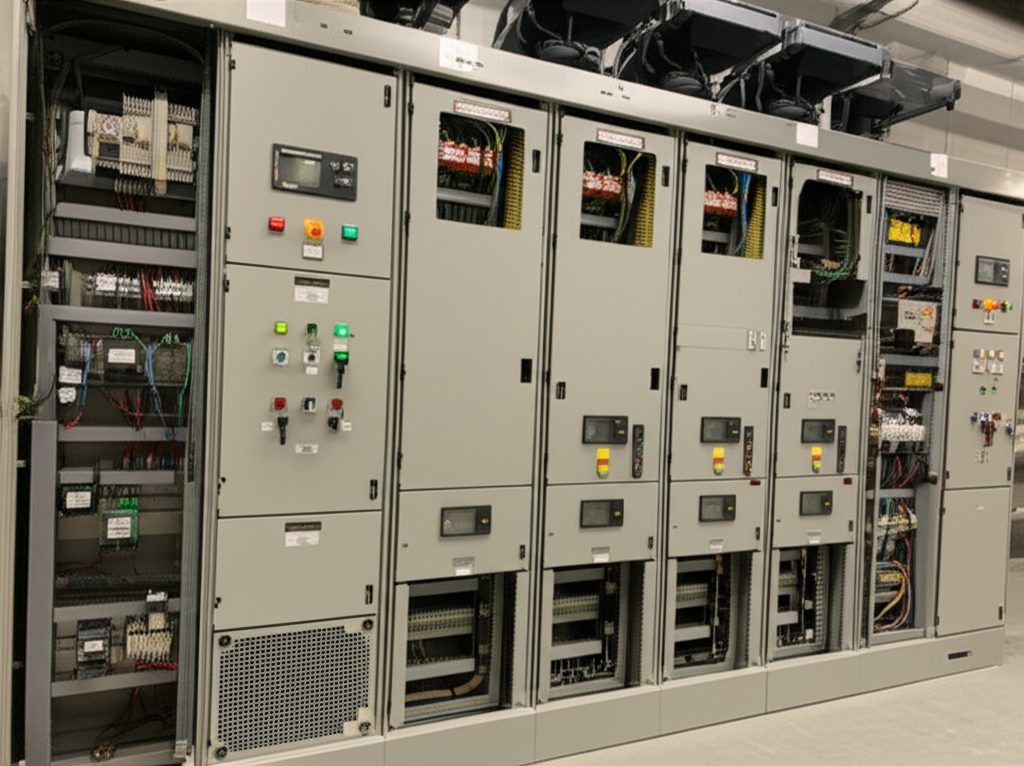
When I first started my career in electrical engineering, I walked onto a factory floor and saw a long row of imposing, gray metal cabinets humming quietly in a dedicated room. They looked like oversized school lockers, but I knew they were something far more important. My mentor pointed at them and said, “That’s the heart of this entire plant. That’s the Motor Control Center.”
Over the years, I’ve designed, installed, and troubleshot countless MCCs. I’ve seen them in everything from sparkling clean food processing plants to rugged, dusty mining operations. And what I’ve learned is that while they might look complex, their purpose is beautifully simple: to safely and efficiently control a large number of electric motors from one central location.
If you’ve ever wondered what these crucial pieces of industrial equipment do, you’ve come to the right place. In this guide, I’ll walk you through everything you need to know about Motor Control Centers, drawing from my own experiences on the factory floor.
Table of Contents
- What Exactly is a Motor Control Center (MCC)?
- The Essential Components of an MCC
- How Does a Motor Control Center Work? (Simplified Operation)
- Types of Motor Control Centers
- Key Benefits and Advantages of Using an MCC
- Common Applications of Motor Control Centers Across Industries
- Safety Standards and Considerations for MCCs
- The Evolution of MCCs: Towards Intelligent and Connected Systems
- MCC vs. Related Equipment: Clarifying the Differences
- Conclusion: Powering Progress with Motor Control Centers
What Exactly is a Motor Control Center (MCC)?
At its core, a Motor Control Center, or MCC, is a centralized assembly of motor starters. But that’s a bit of an oversimplification. Think of it as the command-and-control hub for all the electric motors in a facility. Instead of having a separate starter and control box next to every single pump, fan, conveyor, and compressor, you group them all together in one organized, safe, and efficient lineup of cabinets.
The MCC purpose is fourfold:
Physically, an MCC is a series of connected metal enclosures. Each enclosure, or “section,” is divided into smaller compartments. It’s this modular construction that makes MCCs so flexible and popular in industrial settings.
The Essential Components of an MCC
When you open the door of an MCC section, you’re not just looking at a jumble of wires. It’s a highly organized system with several key components. Let’s break down what’s inside.
Main Busbars
The first thing you need to understand is the power backbone. Running horizontally through the top or back of the entire MCC lineup are thick copper or aluminum bars called busbars. I like to think of them as the main electrical highway. The main power for the entire facility, or a large part of it, comes into these busbars. They carry the heavy current and make it available to every section of the MCC.
Vertical Sections and “Buckets”
Each vertical cabinet in the MCC lineup taps into the main horizontal bus with its own set of vertical busbars. This brings the power down through the section. The real magic of the MCC happens in the individual modular units that plug into these vertical busbars.
We call these removable units “MCC buckets.” A bucket is a self-contained drawer that holds all the necessary components to control a single motor. This is where the action happens. Inside a typical bucket, you’ll find:
Some buckets are more advanced. Instead of a simple contactor, you might find a Variable Frequency Drive (VFD) or a Soft Starter. A VFD gives you precise speed control over the motor, which is fantastic for energy efficiency. A soft starter provides a smooth, gradual ramp-up to full speed, reducing mechanical stress on the equipment during startup.
How Does a Motor Control Center Work? (Simplified Operation)
So, how do all these parts work together? Let’s follow the flow.
- That button sends a low-voltage signal to the control circuit inside the conveyor’s MCC bucket.
- This signal energizes the coil in the contactor.
- The energized contactor snaps its main power contacts shut.
- Power now flows from the busbar, through the circuit breaker, through the contactor, through the overload relay, and out to the motor. The conveyor starts moving.
- All the while, the overload relay is silently monitoring the current. If the conveyor gets jammed and the motor starts to struggle, the relay will detect the excess current and trip, safely shutting everything down.
Modern MCCs are rarely just standalone islands. They’re often integrated with the plant’s main automation system, like a Programmable Logic Controller (PLC) or a SCADA system. In this case, the “start” signal doesn’t come from a button but from the PLC, allowing for complex, automated process control.
Types of Motor Control Centers
Not all MCCs are created equal. Over the years, I’ve worked with various types, and they generally fall into a few distinct categories.
By Construction
- Fixed-Type MCC: In this older style, all the components are permanently bolted inside the enclosure. It’s less expensive upfront, but maintenance is a headache. To replace a faulty starter, you have to shut down the entire MCC, which means significant downtime.
- Withdrawable-Type MCC: This is the modern standard. Each motor controller is in a removable “bucket.” If a starter fails, you can safely de-energize and pull out that one bucket, pop in a spare, and have the motor running again in minutes. I’ve seen this save a plant from hours of lost production—it’s a game-changer for maintenance and uptime.
By Standard
You’ll often hear engineers talk about two main design standards:
- NEMA-Type MCC (North American): Governed by the National Electrical Manufacturers Association, these are the standard in the US. They are known for being robust, heavy-duty, and built in standardized sizes.
- IEC-Type MCC (International): More common in Europe and other parts of the world, International Electrotechnical Commission standards often result in more compact and customizable designs.
By Functionality
This is where things get really interesting.
- Conventional MCC: This is your basic, no-frills MCC. It uses electromechanical relays and hardwired controls. It’s reliable and gets the job done for simple ON/OFF control.
- Intelligent MCC (iMCC / Smart MCC): This is the future of motor control. These MCCs have communication modules in each bucket that talk to the central PLC over an industrial network like Ethernet/IP. Instead of miles of control wiring, you have a single network cable. This gives you a massive amount of data—motor current, voltage, temperature, run-time hours—right at your fingertips. You can diagnose problems remotely and even predict failures before they happen (predictive maintenance).
Key Benefits and Advantages of Using an MCC
Why do we go through the trouble of centralizing everything in an MCC? I’ve found the benefits are undeniable.
- Centralized Control & Management: Having all your motor starters in one place makes operation, troubleshooting, and maintenance vastly simpler. No more hunting around a massive plant for an individual control box.
- Enhanced Safety: Modern MCCs are designed with safety as a top priority. Features like arc flash mitigation, insulated busbars, and secure interlocking mechanisms protect personnel from electrical hazards.
- Space Efficiency: An MCC packs a lot of control into a small footprint. Trying to install individual starters for dozens of motors would take up far more valuable floor space.
- Improved Reliability & Uptime: With withdrawable buckets, you can swap out a faulty unit in minutes, not hours. The centralized nature also makes it easier to implement standardized maintenance checklists.
- Flexibility & Scalability: Need to add another motor to your process? It’s often as simple as ordering a new pre-configured bucket and sliding it into an empty space in the MCC.
- Reduced Installation & Wiring Costs: In my experience, this is a huge one. An MCC is pre-engineered and factory-wired. This drastically reduces the amount of complex and expensive wiring that needs to be done on-site by electricians.
Common Applications of Motor Control Centers Across Industries
If a facility uses a significant number of electric motors, you’ll almost certainly find an MCC. The sheer breadth of motor application across industries guarantees their presence. I’ve seen them running critical processes in:
- Water and Wastewater Treatment: Controlling the massive pumps that move millions of gallons of water every day.
- Oil & Gas Industry: Running pumps, compressors, and drilling equipment on offshore platforms and in refineries.
- Manufacturing Plants: Powering conveyor systems, mixers, presses, and robotic arms in automotive, food and beverage, and consumer goods factories.
- Mining and Mineral Processing: Operating crushers, grinders, and long conveyor belts in some of the harshest environments imaginable.
- HVAC Systems: Managing the large fans and pumps that provide heating and cooling for commercial buildings, hospitals, and data centers.
- Pulp and Paper Mills: Driving the complex machinery that turns wood into paper products.
Safety Standards and Considerations for MCCs
Working with MCCs means working with high voltage, so safety is paramount. We follow strict standards to ensure everyone goes home at the end of the day.
The biggest concern is Arc Flash, a dangerous explosion of energy that can occur during a short circuit. Standards like NFPA 70E dictate safe work practices, including wearing appropriate personal protective equipment (PPE). Modern MCCs are designed with arc-resistant features to contain and redirect this explosive energy away from personnel.
Other key considerations include proper Lockout/Tagout procedures to ensure a circuit is de-energized before maintenance, and ensuring the MCC has the correct NEMA or IP enclosure rating to protect it from its environment (e.g., dust, water).
The Evolution of MCCs: Towards Intelligent and Connected Systems
The MCCs I work with today are worlds apart from the purely electromechanical ones from the start of my career. The shift towards Intelligent MCCs is part of the larger trend of Industry 4.0 and the Industrial Internet of Things (IIoT).
Instead of just being a “dumb” power distribution device, a smart MCC is a data hub. By collecting real-time data from each motor, plant operators can:
- Monitor Energy Consumption: Identify inefficient motors and optimize processes to save on electricity costs.
- Implement Predictive Maintenance: Anomaly detection algorithms can spot signs of a failing motor bearing or pump cavitation long before a catastrophic failure, allowing for scheduled repairs instead of costly unplanned downtime.
- Improve Troubleshooting: When a motor trips, a technician can see the exact fault code and historical data on their laptop without even having to open the MCC door.
MCC vs. Related Equipment: Clarifying the Differences
People often get MCCs confused with other electrical gear. Let me clear up a few common points of confusion from my own experience explaining this to new technicians.
- MCC vs. Control Panel: A control panel is typically a smaller enclosure designed to control a single machine or a very specific process. An MCC is a much larger assembly designed to control many motors across a wide area or entire plant.
- MCC vs. Switchgear: Switchgear is the big gun. It handles the main, high-voltage power coming into a facility and distributes it to things like transformers and MCCs. Its primary job is power distribution and protection at a much higher voltage and current level. An MCC’s primary job is motor control.
- MCC vs. Panelboard: A panelboard (or breaker panel) is what you probably have in your house. It’s a simple cabinet full of circuit breakers for distributing power to lights, outlets, and small loads. An MCC is far more complex, containing not just breakers but also contactors, overload relays, and control circuits.
Conclusion: Powering Progress with Motor Control Centers
From those first humming gray cabinets I saw years ago to the smart, data-rich systems I install today, Motor Control Centers have remained a cornerstone of industrial operations. They are the unsung heroes working behind the scenes, providing the safe, reliable, and centralized control that allows our modern world to function.
They’ve evolved from simple ON/OFF switches to intelligent hubs that provide crucial insights for improving efficiency and reliability. The next time you walk through a factory or see any large industrial facility in action, remember that at its heart, there’s likely a Motor Control Center, quietly orchestrating the power that makes it all possible. If you’re looking to understand the fundamentals of electric motors themselves, a great place to start is by exploring the basic motor principle that governs their operation.