What is a Motor Mount in a Car? Essential Guide to Function, Symptoms, and Replacement
If you’ve ever found yourself stopped at a red light and noticed your whole car vibrating like a cheap motel bed, or heard a loud “clunk” every time you shift gears, you’ve likely come face-to-face with the work of a failing motor mount. It’s one of those car parts you probably never think about until it starts causing problems. You’re not alone. Many drivers experience these symptoms and wonder if it’s a serious transmission issue or something else entirely. The good news? It’s often a worn-out motor mount, a critical but replaceable component.
Motor mounts are the unsung heroes of your vehicle’s powertrain. They are the tough, silent partners that hold your engine and transmission in place, ensuring a smooth, quiet, and stable ride. But when they fail, the effects can range from mildly annoying to downright damaging for other parts of your car.
If you’re trying to diagnose a strange noise, understand the importance of this component, or figure out what a potential repair might entail, you’re in the right place. We’re going to break it all down.
What We’ll Cover
- The Core Function of Motor Mounts: What they actually do for your car.
- Anatomy of a Motor Mount: What they’re made of and the different types.
- Key Symptoms of a Bad or Failing Motor Mount: The tell-tale signs to watch and listen for.
- Common Causes of Motor Mount Failure: Why these sturdy parts eventually wear out.
- What Happens If You Don’t Replace a Bad Mount: The risks of ignoring the problem.
- Motor Mount Replacement: Costs, considerations, and whether you can DIY it.
- How Many Motor Mounts Does a Car Have? A look at typical configurations.
- Frequently Asked Questions (FAQs): Quick answers to common questions.
The Core Function of Motor Mounts
Think of motor mounts as the sophisticated bridge between your powerful, vibrating engine and the frame of your car that you sit in. Without them, driving would be an incredibly noisy, shaky, and unpleasant experience. Their job is threefold: supporting, absorbing, and protecting.
Supporting the Engine and Transmission
First and foremost, motor mounts carry the entire weight of your engine and transmission. This combined unit, often called the powertrain, is one of the heaviest and most vital parts of your vehicle. The mounts securely bolt the powertrain to the vehicle’s chassis or subframe, ensuring it stays exactly where it’s supposed to be—no matter if you’re accelerating hard, taking a sharp turn, or driving over bumpy roads. They are the foundation that keeps everything aligned and stable in the engine bay.
Absorbing Vibrations and Shocks
An internal combustion engine, by its very nature, creates a ton of vibration. Pistons firing, crankshafts turning—it’s a controlled explosion happening thousands of times per minute. The primary job of a motor mount is to act as a shock absorber for this energy. Using materials like rubber, they dampen these vibrations, isolating them from the car’s frame.
This dampening effect is what gives you a smooth feeling inside the cabin. A good set of motor mounts prevents you from feeling every little shudder from the engine at idle or the jolt that occurs when your transmission shifts gears. They effectively soak up the noise, vibration, and harshness (NVH) that would otherwise make your ride feel raw and uncomfortable.
Protecting Other Vehicle Components
By locking the engine in place, motor mounts also play a crucial protective role. Imagine if your engine could rock back and forth every time you hit the gas. This excessive movement would put immense stress on all the components connected to it.
Hoses (like radiator and coolant hoses), sensitive electrical wiring, the exhaust system, and even the driveshaft and axles would be constantly yanked and strained. This could lead to fluid leaks, electrical failures, cracked exhaust manifolds, and premature wear on drivetrain components. In short, motor mounts prevent your engine’s torque and movement from tearing its own support systems apart.
Anatomy of a Motor Mount: What Are They Made Of?
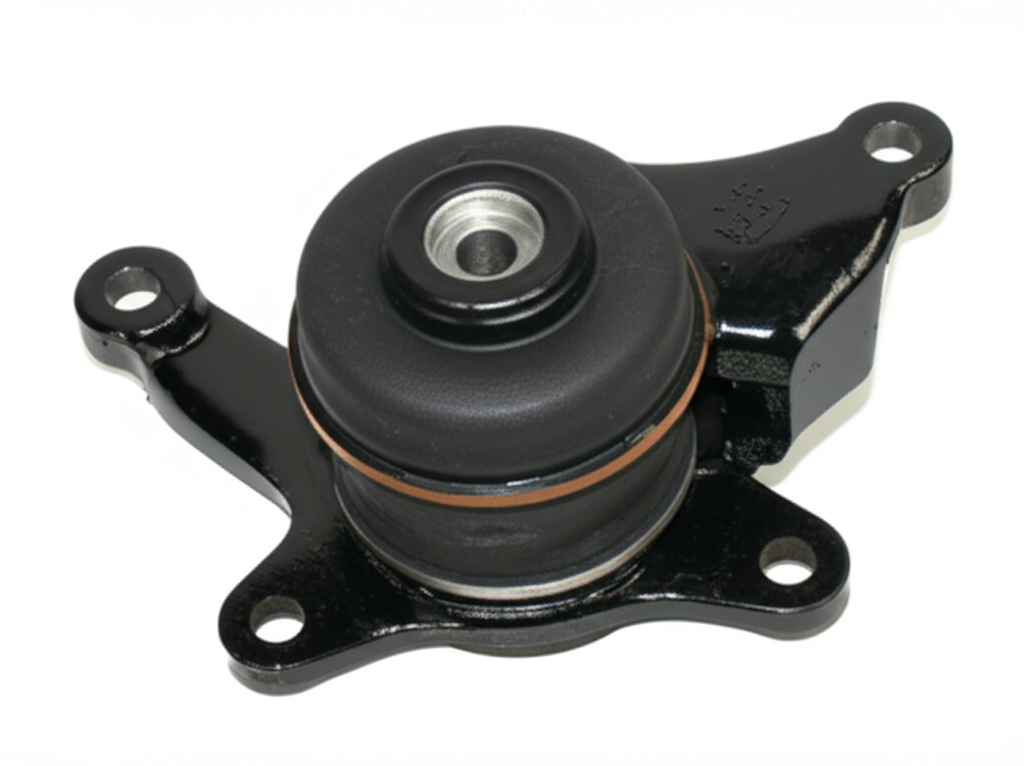
At first glance, a motor mount looks simple—just a block of rubber sandwiched between two metal plates. But there’s more engineering packed into that little component than you might think.
Rubber Insulators
The heart of most motor mounts is a block of dense, specially formulated rubber. Rubber is the perfect material for this job because it’s strong enough to support the engine’s weight but flexible enough to absorb vibrations. It acts as an insulator, breaking the metal-on-metal connection between the engine and the chassis that would otherwise transfer every single shake and shudder directly into the cabin.
Metal Brackets
The rubber is typically bonded or encased between two metal attachment plates or brackets. One side bolts directly to the engine block or transmission housing, while the other bolts to the car’s frame or subframe. These brackets are made of steel or aluminum to provide the necessary structural strength and rigidity to hold everything securely.
Types of Motor Mounts
Not all motor mounts are created equal. Depending on the vehicle’s design, cost, and performance goals, manufacturers use several different types.
- Standard Rubber Mounts: These are the most common and cost-effective type, consisting of the simple rubber-and-metal design. They offer a good balance of vibration control and durability for most daily driving applications.
- Hydraulic Mounts (Hydro-Mounts): Found more often in luxury or higher-end vehicles, these are a major step up. They look similar to standard mounts but are filled with hydraulic fluid. Inside, a system of chambers and passages allows the fluid to move back and forth, making them exceptionally good at dampening vibrations across a wider range of engine speeds. They provide a much smoother and quieter ride but are more complex and expensive to replace.
- Vacuum-Controlled (Active) Mounts: The most advanced type, these are essentially “smart” mounts. They are connected to the car’s computer (ECU) via vacuum lines and can change their stiffness in real-time. At idle, the mount can become softer to better absorb vibrations. During acceleration or cornering, it can stiffen up to provide better engine control and responsiveness. This gives engineers the best of both worlds: comfort and performance.
- Solid/Polyurethane Mounts: On the other end of the spectrum are solid metal or stiff polyurethane mounts. You’ll rarely find these from the factory on a standard passenger car because they transfer a lot of vibration into the cabin. However, this type of mount is a popular upgrade in various high-performance motor application scenarios, from track cars to heavily modified street vehicles. By eliminating engine flex, they ensure maximum power is transferred to the wheels and provide a more connected feel for the driver, at the expense of comfort.
Key Symptoms of a Bad or Failing Motor Mount
Since motor mounts wear out gradually, the symptoms can start subtly and get worse over time. If you notice any of the following signs, it’s a good idea to have your mounts inspected.
Excessive Vibrations
This is the number one symptom. A worn-out mount has lost its ability to absorb engine vibrations, so that energy is transferred directly to the car’s frame. You might feel this as:
- A noticeable vibration in the steering wheel, floorboards, or seats.
- The vibration is often worst when the car is in “Drive” but stopped at a light.
- It might smooth out as you start moving but reappear at certain engine speeds (RPMs).
Loud Clunking or Banging Noises
When the rubber in a mount is completely torn or separated, the engine is no longer held securely. This allows the heavy metal engine block to shift and bang against the frame. These noises are most common during moments of high engine torque, such as:
- Loud clunking when you shift from Park to Drive or Reverse.
- A banging sound during hard acceleration or deceleration.
- Impact noises when driving over bumps or potholes.
Engine Shifting or Rocking
In severe cases, you can actually see the engine moving. With the car in Park and the hood open (and standing safely to the side), have a friend briefly rev the engine. If a mount is broken, you’ll see the engine lift up or rock significantly more than the usual gentle hum. A little movement is normal, but a jump of several inches is a clear sign of a problem.
Impact on Shifting and Drivability
A loose engine can throw off the alignment of the entire drivetrain. This can sometimes manifest as harsh or jerky gear changes, especially in front-wheel-drive vehicles where the transmission and axles are directly affected by engine position. In some cases, it may even feel like the car is struggling to engage gears properly.
Visible Deterioration
Sometimes, a simple visual inspection can reveal the problem. If you can see the motor mounts, look for deep cracks, tears, or signs of the rubber separating from the metal brackets. For hydraulic mounts, any sign of fluid leaking from the mount is a dead giveaway that it has failed.
Common Causes of Motor Mount Failure
Motor mounts are built to be tough, but they don’t last forever. Several factors contribute to their eventual demise.
- Age and General Wear and Tear: This is the most common culprit. According to industry data, over 80% of failures are simply due to the rubber degrading over time. After years of constant vibration and supporting heavy loads, the rubber naturally becomes hard, brittle, and prone to cracking. A typical lifespan is around 5 to 7 years or 50,000 to 100,000 miles.
- Environmental Factors: The engine bay is a hostile environment. Constant exposure to extreme heat, road salt, and chemicals can accelerate the breakdown of the rubber. Furthermore, fluid leaks from other components, such as an oil pan gasket or power steering hose, can saturate the mount and cause the rubber to swell and soften, destroying its integrity.
- Driving Habits and Conditions: How you drive matters. Aggressive driving with frequent hard acceleration and braking puts immense strain on the mounts. Constantly driving on rough, pothole-filled roads also subjects them to repeated impacts. In more extreme cases, an accident or significant impact can break a mount instantly.
What Happens If You Don’t Replace a Bad Motor Mount?
Ignoring a bad motor mount isn’t just about putting up with some noise and vibration. It can lead to a cascade of other, more expensive problems. A bad motor mount is one common motor problem that can lead to a cascade of others if ignored.
Accelerated Wear on Other Components
When your engine is flopping around, it puts tremendous stress on everything attached to it. This can cause:
- Exhaust System Damage: The connection from the engine’s exhaust manifold to the rest of the exhaust system can crack or break from the excessive movement.
- Damaged Hoses and Belts: Radiator hoses can be stretched to their breaking point, and serpentine belts can be misaligned, leading to premature wear or failure.
- Drivetrain Stress: The constant jolting can cause premature failure of CV joints and axles, which can be a costly repair. Studies have shown this can lead to CV joints failing 20-30% earlier than they otherwise would.
Potential Damage to Engine and Transmission
In extreme cases of failure where multiple mounts are broken, the engine can shift so much that it causes direct damage. It could potentially damage the radiator, A/C condenser, or other components it impacts. While rare, it’s a risk not worth taking.
Decreased Safety and Comfort
Beyond the damage, it’s a matter of control. A severely loose engine can affect vehicle handling and stability. The constant, severe vibrations are also fatiguing for the driver and can make the car feel unsafe and unpredictable.
Motor Mount Replacement: Costs and Considerations
So, you’ve diagnosed a bad motor mount. What’s next? The cost can vary wildly depending on your car and the specific mount that needs replacing.
Typical Replacement Cost Factors
- Parts Cost: A standard aftermarket rubber mount might cost anywhere from $50 to $200. However, a sophisticated hydraulic or active mount from the OEM (Original Equipment Manufacturer) could run from $150 to over $500 for a single part.
- Labor Cost: This is the biggest variable. Some mounts are easily accessible at the top of the engine bay and might only take an hour to replace. Others, especially rear mounts, might be buried deep under other components, requiring 3-4 hours of labor or more. With shop labor rates typically between $75 and $150 per hour, you can see how this adds up.
- Total Cost: For a single, easy-to-access mount on a common vehicle, you might pay between $200 and $400. For a more complex mount or a luxury vehicle, that cost can easily climb to $600 or more. If you need to replace all 3-4 mounts, the total cost could range from $500 to over $1500.
DIY vs. Professional Replacement
Can you replace a motor mount yourself? Maybe. If you’re an experienced home mechanic with the right tools, replacing an easily accessible mount can be a manageable weekend project. However, you’ll need a good set of tools, including a torque wrench and, most importantly, a way to safely support the engine (like an engine hoist or a floor jack with a block of wood).
For most people, this job is best left to a professional mechanic. They have the experience, the specialized tools, and the ability to safely handle a heavy engine. Given the importance of the part and the risks involved, paying for professional installation is often the wisest choice.
How Many Motor Mounts Does a Car Have?
Most cars typically have either three or four motor mounts. The exact configuration depends on the engine layout (longitudinal vs. transverse) and whether the vehicle is front-wheel, rear-wheel, or all-wheel drive.
In a typical front-wheel-drive car with a transverse engine, you might find:
- One mount near the crankshaft pulley (often called the side mount).
- One mount on the transmission side.
- A third mount, often called a torque strut or “dog bone,” positioned to prevent the engine from rocking back and forth during acceleration.
This setup is designed to counteract the rotational forces generated by the engine, a core aspect of the internal combustion motor principle. The mounts work together as a system to keep the powertrain stable from all angles.
Conclusion: The Unsung Hero of Your Car’s Smooth Ride
Motor mounts are a perfect example of a small part playing a massive role. They work tirelessly in the background, absorbing incredible forces to provide the comfort, stability, and reliability we expect from our vehicles.
While their eventual failure is a normal part of a car’s life cycle, recognizing the symptoms early is key. Addressing a bad motor mount promptly not only restores your car’s smooth ride but also protects you from a chain reaction of more complex and expensive repairs down the road. So next time you enjoy a quiet, vibration-free drive, give a little nod to the humble motor mounts doing their job.
Frequently Asked Questions (FAQs)
Q: Can you drive with a bad motor mount?
A: You can for a short time, but it’s not recommended. While the car will still run, you risk causing accelerated wear and damage to other critical components like the exhaust system, hoses, and drivetrain parts. If you hear loud banging or feel severe vibrations, you should get it fixed as soon as possible.
Q: How long do motor mounts typically last?
A: The lifespan varies, but a general estimate is 5-7 years or 50,000-100,000 miles. However, factors like driving conditions, climate, and exposure to fluid leaks can cause them to fail sooner.
Q: Is it expensive to replace a motor mount?
A: It can be. The total cost for a single mount replacement typically ranges from $200 to $600, but it can be higher depending on the vehicle’s make and model, the type of mount (standard vs. hydraulic), and how difficult it is to access.
Q: Can a bad motor mount cause engine damage?
A: In very severe cases where multiple mounts have failed, the engine can move enough to impact and damage other components in the engine bay, such as the radiator or fans. More commonly, it causes indirect damage by stressing connected systems.
Q: How do I know which motor mount is bad?
A: A mechanic can diagnose this through a visual inspection and by observing the engine’s movement when put into gear or revved. They look for the area with the most excessive movement to pinpoint the failed mount. It’s often recommended to replace them in pairs or as a set, as the failure of one mount puts extra stress on the others.