What is a Shaded Pole Motor? The Simple Secret Inside Your Fan
Have you ever wondered what makes the blades on a small desk fan spin? Or how the turntable in your microwave oven goes around? The answer is often a small, simple motor called a shaded pole motor. It’s the hidden hero in many of our everyday gadgets. This article will show you exactly what this motor is, how it works in a super simple way, and why it’s used in so many things around your home. You’ll soon see why this little engine is a big deal.
Table of Contents
- What is a Shaded Pole Motor Anyway?
- How Does This Simple Motor Actually Work?
- What Are the Main Parts of a Shaded Pole Motor?
- Why Would Someone Choose a Shaded Pole Motor?
- Are There Any Downsides to Using Them?
- Where Can You Find These Motors in Your Home?
- How Does It Compare to Other Small Motors?
- Why Quality Parts Matter Even in Simple Motors
- A Quick Look at Shaded Pole Motor Facts
- What’s the Final Word on These Motors?
What is a Shaded Pole Motor Anyway?
A shaded pole motor is a type of single phase induction motor. That might sound complicated but think of it like this: it’s a very basic electric motor that can run on the regular AC power from your wall outlet. It’s known as a self-starting motor which means it doesn’t need any special switches to get it going. You just give it power and it starts to spin.
Its most special feature is something called a “shading coil” or a “shading ring.” This is just a simple loop of copper wire that gives the motor its name and its ability to start spinning all by itself. These motors are famous for their simple motor design, making them a cheap electric motor to produce. They are a type of AC induction motor and you’ll find them in jobs that don’t need a lot of power.
How Does This Simple Motor Actually Work?
The way this motor works is pretty clever. It all comes down to electromagnetic induction, which is just a fancy way of saying that electricity and magnets can work together to create motion. When you plug the motor in the main stator winding gets electricity and creates a magnetic field. This field is constantly changing because AC power flips back and forth.
Now here comes the magic part: the shading coil. This copper ring is on just one part of the motor’s pole. Because of the eddy current effect, the magnetic field in that “shaded” part gets a little bit delayed. This creates a tiny phase shift in magnetic field. Imagine you’re pushing a merry-go-round. Instead of one big push you give it a quick one-two push. This one-two effect creates a weak rotating magnetic field.
This moving magnetic field then works on the rotor. The rotor is usually a squirrel cage rotor which has metal bars in it. The magnetic field creates an induced current in these bars. This new current creates its own little magnetic field that gets pushed and pulled by the first one. This pushing and pulling is what creates the turning force or torque production mechanism that makes the motor spin. It’s a clever and simple way to get magnetic field rotation from a single-phase power supply. This is the whole shaded pole motor principle.
What Are the Main Parts of a Shaded Pole Motor?
Have you ever bought a simple gadget that broke down way too soon? Sometimes it’s because the parts inside were made poorly. A motor is only as good as its parts and even a simple one can fail if the components aren’t right. It’s frustrating when a simple fan or pump stops working just because a manufacturer used a low-quality part to save a few pennies.
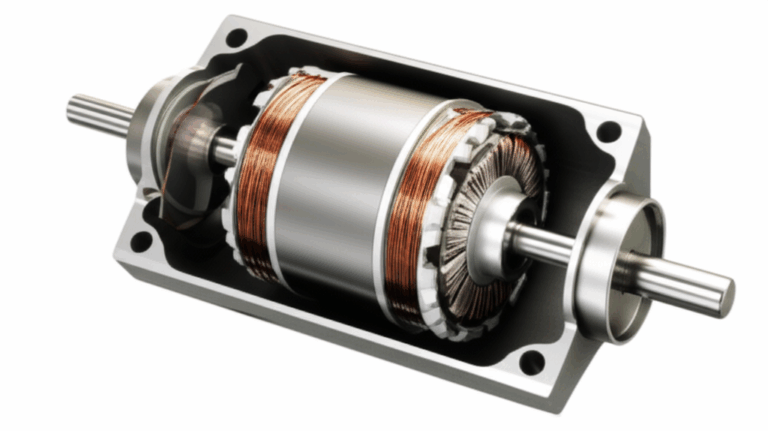
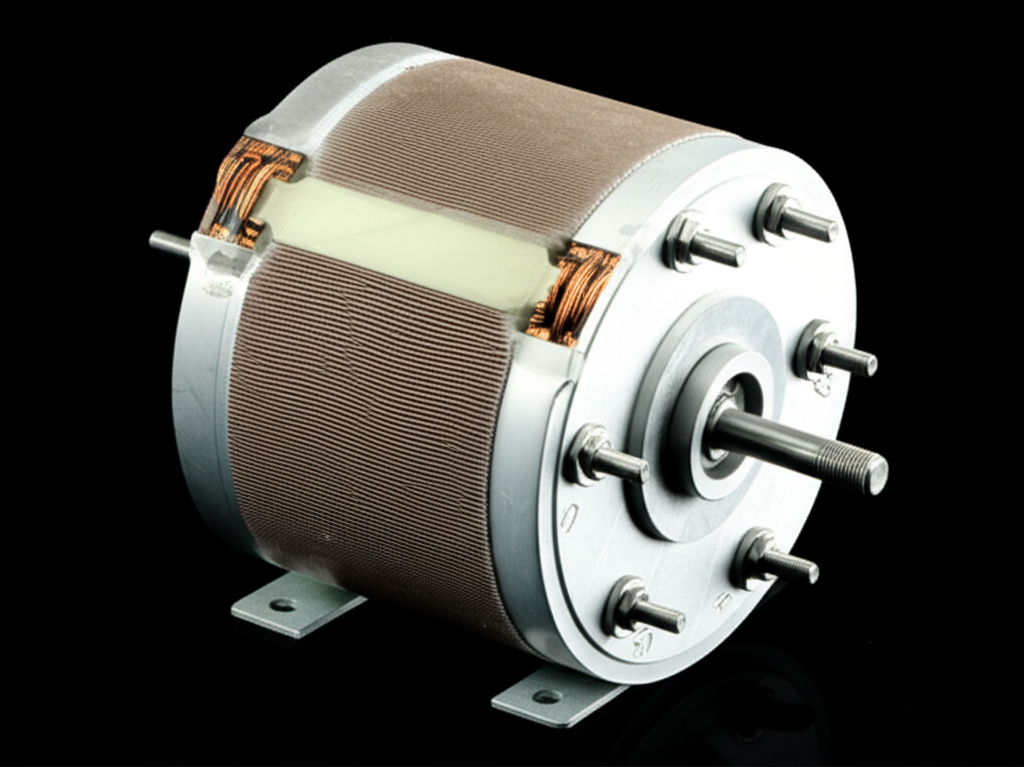
Let’s look inside a shaded pole motor. It has very few parts which is why it’s so reliable.
- The Stator: This is the outside part that doesn’t move. It’s made from a laminated stator core which are thin sheets of metal stacked together. Using high-quality stator core lamination is super important to reduce energy loss. The main wire coil or motor winding is wrapped around the stator’s salient poles. And of course each pole has a slot cut into it for the special copper shading ring.
- The Rotor: This is the part that spins. In most shaded pole motors it’s a squirrel cage rotor. It’s also made of laminated metal with copper or aluminum bars running through it. The best rotors use precision-made rotor core lamination to ensure they spin smoothly and efficiently. There are no wires or brushes connected to the rotor. It just spins freely inside the stator.
- The Shading Coil: This is the key part. It’s a single loop of thick copper wire, like a ring, that is short-circuited. Its whole job is to delay the magnetic field on one side of the pole to get the motor spinning. The shading coil function is the secret to its self-starting ability.
This is where quality really makes a difference. At Sino Lami we create the high-precision core lamination stacks that form the heart of these motors. Using top-grade electrical steel laminations means the motor runs cooler and lasts longer. It turns a simple design into a truly dependable motor.
Why Would Someone Choose a Shaded Pole Motor?
You might be thinking if this motor is so simple and not very powerful why is it so popular? Well its simplicity is its superpower. Here are the main advantages of a shaded pole motor.
First they are incredibly cheap to make. The cost per unit is the lowest of almost any AC motor. For companies making millions of household appliances keeping costs down is a big deal. The simple manufacturing process and few parts make it a very cost-effective motor solution.
Second they are tough and reliable. A robust motor construction means they can run for years without any problems. There are no brushes or switches to wear out which are common points of failure in other motors. This makes it a low maintenance motor with great motor reliability.
Finally they are small and quiet. Their compact size makes them perfect for squeezing into small gadgets. The quiet motor operation is a huge plus for things like a dehumidifier motor in your bedroom or a fan on your desk.
Are There Any Downsides to Using Them?
Of course no motor is perfect for every job. The shaded pole motor has some clear limitations and knowing them helps understand why it isn’t used for everything. These are the main disadvantages of a shaded pole motor.
The biggest weakness is its low starting torque. This means it can’t get heavy things moving. It’s like trying to start riding a bike in its highest gear. You can’t use it for things like air compressors or washing machines. The torque requirement for its applications must be very low.
Another big downside is its low motor efficiency. A lot of the electricity it uses is wasted as heat. This is due to the way it works and the eddy current losses. Its power factor is also very low. This means it’s not a good choice for something that runs all the time because the energy consumption would be too high. Think of it like a car that gets bad gas mileage. It’s fine for short trips but not for a long journey.
Also it’s a unidirectional motor. This means it can only spin in one direction. You can’t easily make it go backwards. Finally it’s a fixed speed motor. Its speed is set by the AC power frequency so you can’t really change its RPM without special equipment.
Where Can You Find These Motors in Your Home?
Now for the fun part! Let’s go on a scavenger hunt around your house. You’ll be surprised how many shaded pole motor applications you can find. Because they are a fractional horsepower motor they are perfect for light-duty jobs.
- Fans, Fans, and More Fans: This is their most common use. Look in a small exhaust fan motor in your bathroom a desk fan or the small cooling fan inside a computer or projector. That gentle fan blade rotation is likely powered by a shaded pole motor.
- Kitchen Gadgets: Your microwave oven motor that spins the turntable is a perfect example. Some small can openers or electric knives might use them too.
- Air Quality and Comfort: The motor in a humidifier motor or a refrigerator defroster motor is often a shaded pole type. Hair dryers also use them to blow the air.
- Pumps and Timers: Small water pumps for fish tanks or little decorative fountains use them. Old-school electric clocks and appliance timers often had a tiny shaded pole motor as a time delay mechanism motor.
You can see they are the perfect choice for many household appliance motor needs where low cost and simple operation are more important than power or efficiency. Understanding these motor application scenarios helps you see why different motor types exist.
How Does It Compare to Other Small Motors?
It’s helpful to see how the shaded pole motor stacks up against other common single-phase motor types. This helps explain the motor selection criteria an engineer uses.
- Capacitor Motor vs Shaded Pole: A capacitor-start motor has a special part called a capacitor that gives it a big boost to start. This means it has much higher starting torque and is more efficient. You’ll find these in things like washing machines or air conditioners. They are more expensive and complex.
- Split Phase Motor Comparison: A split-phase motor is a step up from a shaded pole. It uses a special starting winding and a switch to get more starting torque. It’s better than a shaded pole motor but still not as powerful or efficient as a capacitor motor.
- Universal Motor vs Shaded Pole: A universal motor is the type you find in a blender or a power drill. It’s very powerful for its size and has very high starting torque. But it has brushes that wear out and it can be very noisy.
So you see the shaded pole motor has its own special place. It’s for when you don’t need much power you don’t want to spend much money and you need it to be simple and quiet.
Why Quality Parts Matter Even in Simple Motors
You might think that for such a cheap simple motor the quality of its inner parts doesn’t matter much. But that’s where many go wrong. A poorly made motor can overheat make noise and fail early. Imagine buying a new bathroom fan only to have it start rattling and die after a few months. This is a common motor problem. The issue often comes down to the motor core laminations.
The stator and rotor cores are made of thin sheets of steel. If these laminations aren’t stamped perfectly or if they are made from low-grade silicon steel laminations the motor will lose a lot of energy as heat. This wasted energy not only makes your electric bill higher but it can also cause the motor’s windings to burn out. This leads to shaded pole motor failures.
This is why our work at Sino Lami is so important. We provide the best motor core laminations to motor manufacturers. Our precision engineering ensures that every piece fits perfectly. This reduces noise vibration and energy loss. So even though the shaded pole motor is a simple and cheap design using our high-quality core lamination stacks makes it incredibly reliable and efficient for its type. It’s the smart choice for building a product that lasts.
A Quick Look at Shaded Pole Motor Facts
Let’s break down the key features of a shaded pole motor in a simple table. This will give you a quick reference for its characteristics.
| Feature / Metric | Shaded Pole Motor Details | What This Means for You |
|---|---|---|
| Efficiency | 5% – 40% | It uses more electricity for the work it does. Best for things you don’t use 24/7. |
| Starting Torque | Very Low | It can’t start with a heavy load. Perfect for fans where the load is very light at first. |
| Cost | Very Low | This is why products that use them are so affordable. |
| Power Output | Very Small (Fractional HP) | It’s made for light-duty jobs only like spinning a fan blade not a saw blade. |
| Lifespan | 5 – 10 years | Very reliable and long-lasting because it has so few moving parts to break. |
| Speed Control | None (Fixed Speed) | It runs at one speed which is fine for a fan or a timer. |
| Noise Level | Generally Low | It’s quiet making it great for appliances you use inside your home. |
What’s the Final Word on These Motors?
The shaded pole motor is a fantastic piece of electrical engineering. It’s a perfect example of a design that does one thing simply and does it well. It’s not the strongest or the most efficient motor out there. But for countless small gadgets that need a cheap reliable and quiet way to spin something it’s the undisputed champion.
It’s the unseen workhorse that keeps our fans blowing our microwaves turning and our air fresh. Its clever design based on a simple shading coil has made so many of our modern conveniences possible and affordable. So the next time you feel a cool breeze from a small fan give a little nod to the humble but mighty shaded pole motor whirring away inside.
Key Things to Remember
- A shaded pole motor is a simple cheap AC motor that starts on its own.
- It uses a special “shading coil” to create a weak rotating magnetic field.
- It has very low starting power and is not very efficient.
- Its main advantages are low cost simple construction and high reliability.
- You can find them everywhere in small fans pumps and household appliances.
- The quality of its internal parts like the stator and rotor laminations is key to its lifespan.