What Is a Squirrel Cage Motor? Design, Working Principle, Advantages & Key Applications
Have you ever wondered what makes the world go around? Well, a lot of the time, it’s a simple yet powerful little engine called a squirrel cage motor. These motors are everywhere, from the fan that cools you on a hot day to the massive machines in factories that build our cars and appliances. But what is a squirrel cage motor, and how does it work? Don’t worry, it’s not as complicated as it sounds! This guide will break down everything you need to know about this amazing invention, from its clever design to its everyday uses, in simple terms anyone can understand. By the end, you’ll see why this motor is the unsung hero of our modern world.
Table of Contents
- What is a Squirrel Cage Motor?
- How Does a Squirrel Cage Motor Work?
- What are the Main Components of a Squirrel Cage Motor?
- What are the Advantages of Using a Squirrel Cage Motor?
- What are the Disadvantages and Limitations?
- Where are Squirrel Cage Motors Used?
- What’s the Difference: Squirrel Cage vs. Wound Rotor Motors?
- Keeping Your Squirrel Cage Motor Running
- Conclusion: The Quiet Powerhouse of Our World
- Frequently Asked Questions (FAQ)
What is a Squirrel Cage Motor?
At its heart, a squirrel cage motor is a type of AC motor—specifically, an induction motor. Think of it as a reliable workhorse. It doesn’t need a lot of fuss to get going, it’s tough, and it’s built to last. It gets its funny name from one of its key parts, the rotor, which looks a lot like the exercise wheel you’d find in a pet’s cage.
This motor is famous for its simple and robust construction. Unlike some other motors, it doesn’t have brushes or other parts that wear out quickly. This simplicity is what makes it so popular and widely used in everything from household appliances to heavy industrial machinery. It’s a true champion of electrical engineering.
How Does a Squirrel Cage Motor Work?
Ever tried to hold two magnets together and felt them push or pull? A squirrel cage motor works on a very similar principle, but with electricity and magnetism working together. It’s a brilliant piece of engineering that seems like magic but is all based on solid science.
The Stator: Creating the Rotating Magnetic Field
First, let’s talk about the stator. The stator is the stationary part of the motor that stays put. It’s basically a hollow cylinder made up of stacked steel plates called laminations. Wrapped around these laminations are coils of wire. When you plug the motor in, alternating current (AC) flows through these coils.
This flow of electricity creates a powerful magnetic field. Because the AC current is constantly changing direction, this magnetic field isn’t still; it spins around the inside of the stator. This is called the Rotating Magnetic Field (RMF). The speed at which this field spins is called the synchronous speed. Imagine a ghost chasing its own tail in a circle—that’s kind of what the RMF is doing inside the motor!
The Rotor: Induction and Torque Generation
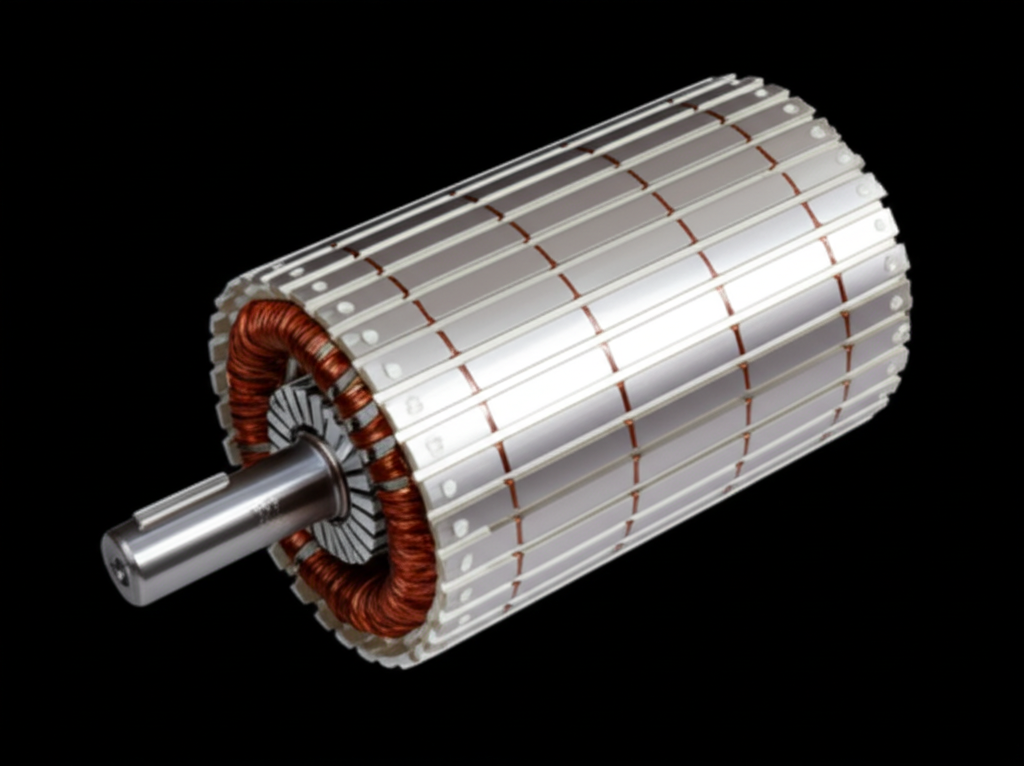
Now for the fun part: the rotor. The rotor is the part that spins. In a squirrel cage motor, the rotor is made of thick bars of copper or aluminum connected at both ends by end rings. It looks just like a cage you might see for a small animal, which is how it got its name.
When the RMF from the stator sweeps across the rotor bars, something amazing happens. According to Faraday’s Law of Induction, a voltage and then a current are “induced” in the rotor bars. This is the same principle that allows generators to create electricity. Now, because the rotor bars are connected by the end rings, this current flows in a closed loop.
This flow of current creates its own magnetic field around the rotor. Thanks to another cool physics principle called Lenz’s Law, this new rotor magnetic field tries to “oppose” the change that created it. In simpler terms, the rotor’s magnetic field starts chasing the stator’s rotating magnetic field. This chase creates a turning force, or torque, on the rotor, making it spin. The shaft connected to the rotor then turns whatever the motor is connected to, like a fan blade or a pump.
The Concept of “Slip”: Why the Rotor Chases the Field
Here’s a tricky but important idea: the rotor never quite catches up to the speed of the stator’s magnetic field. There’s always a slight difference in speed, and this is called slip. If the rotor were to spin at the exact same speed as the magnetic field (synchronous speed), the magnetic field wouldn’t be “cutting across” the rotor bars anymore. Without that cutting action, no current would be induced, and there would be no magnetic force to turn the rotor. So, the rotor has to spin slightly slower to keep the whole process going. This slip is what allows the motor to produce torque and do its job.
Anatomy of a Squirrel Cage Motor: Key Components
Let’s break down the main parts of this amazing machine. Even though it’s simple, each part has a very important job to do.
Stator Assembly
- Laminated Core: This isn’t just a solid chunk of metal. The stator core is made from thin, stacked steel sheets called electrical steel laminations. These laminations are insulated from each other to reduce energy loss from something called “eddy currents.” Think of it as making the magnetic field more efficient.
- Stator Windings: These are coils of insulated copper wire neatly placed into slots in the stator core. When electricity flows through these windings, it creates the rotating magnetic field that is the heart of the motor’s operation. The quality and arrangement of these windings are crucial for the motor’s performance and efficiency.
- Motor Frame/Housing: This is the outer shell of the motor. It holds everything together, protects the delicate internal parts from dust and moisture, and helps dissipate the heat generated during operation.
Squirrel Cage Rotor Assembly
- Laminated Core: Just like the stator, the rotor’s core is also made of stacked laminations. This helps to concentrate the magnetic field and reduce energy loss.
- Rotor Bars: These are bars of copper or aluminum that run through the slots in the rotor core. They are the pathways for the induced electric current.
- End Rings: At each end of the rotor, these rings connect all the rotor bars together, creating a closed electrical circuit. This is what completes the “cage” shape and allows the current to flow freely, generating the magnetic field that makes the motor turn.
- Shaft: This is the steel rod that runs through the center of the rotor. It sticks out of the motor housing and is connected to the machine or device the motor is designed to power, like a fan blade, a pump impeller, or a gear.
Auxiliary Components
- Bearings: Located at both ends of the shaft, these allow the rotor to spin smoothly and with very little friction. They are critical for the motor’s lifespan and quiet operation.
- Cooling Fan: Attached to the shaft, this fan spins with the rotor and blows air over the motor’s housing to keep it from overheating.
- Terminal Box: This is the small box on the side of the motor where the electrical wires from the power source are connected.
Advantages of Squirrel Cage Motors: Why They Dominate
There’s a reason you find squirrel cage motors in everything from your washing machine to giant industrial pumps. They have some fantastic benefits that make them the go-to choice for most applications.
- Simple & Robust Construction: They have very few moving parts. There are no brushes or commutators to wear out, which makes them incredibly durable and less prone to mechanical failure.
- High Reliability & Durability: Because of their simple design, these motors can run for years, even in tough conditions, with minimal problems. They are the workhorses of the industry.
- Low Maintenance: No brushes to replace means less downtime and lower maintenance costs over the motor’s life. A little bit of cleaning and bearing lubrication is often all they need.
- Cost-Effective: Their straightforward design makes them cheaper to manufacture compared to other types of motors, which makes them more affordable to buy.
- Good Efficiency: Modern squirrel cage induction motors are designed to be highly efficient, especially when running at or near their full rated load. This means they convert more electrical energy into useful mechanical work, saving electricity and money.
Disadvantages and Limitations to Consider
Of course, no motor is perfect for every single job. Squirrel cage motors have a few limitations you should be aware of.
- High Starting Current: When a squirrel cage motor first starts, it can draw a very high amount of electrical current—sometimes 5 to 7 times its normal running current. This can cause a temporary voltage dip in the electrical system, which might affect other equipment.
- Lower Starting Torque: Compared to some other motor types, their starting torque (the twisting force they generate when starting up) is relatively low. This makes them less suitable for applications that need to start under a very heavy load.
- Fixed Speed Operation: The speed of a standard squirrel cage motor is directly tied to the frequency of the AC power supply. This means it’s not easy to change its speed. However, this limitation can be overcome by using a Variable Frequency Drive (VFD), an electronic device that can change the frequency of the power supplied to the motor, allowing for precise speed control.
- Poor Power Factor at Light Loads: When the motor isn’t working hard (running under a light load), its efficiency drops, and it can have a poor power factor. This means it draws more current than necessary from the power grid, which can sometimes result in penalties from the electric company.
Common Applications: Where You’ll Find Squirrel Cage Motors
You’ve probably used a dozen devices with squirrel cage motors today without even realizing it. Their reliability and simplicity make them perfect for a huge range of jobs.
Industrial Machinery:
- Pumps: Moving water, oil, and other fluids in factories and water treatment plants.
- Fans and Blowers: Powering ventilation systems in buildings, tunnels, and mines. They are also the heart of HVAC systems.
- Compressors: Used in refrigeration systems and for supplying compressed air in workshops.
- Conveyor Belts: Moving products along assembly lines and in distribution centers.
- Machine Tools: Driving lathes, drills, and grinders with steady power.
Commercial and Domestic Appliances:
- Washing Machines and Dryers: Tumbling your clothes clean and dry.
- Refrigerators and Freezers: Running the compressor to keep your food fresh.
- Dishwashers: Powering the pump that sprays water onto your dishes.
- Power Tools: The reliable motor in many drills, saws, and sanders.
- Garage Door Openers: Lifting that heavy door with ease.
What’s the Difference: Squirrel Cage vs. Wound Rotor Motors?
You might hear about another type of induction motor called a “wound rotor” motor. So, what’s the difference? The main difference is in the rotor’s design.
- Squirrel Cage Motor: Has a simple, rugged rotor made of cast bars shorted by end rings. It’s like a hamster wheel. It offers simple construction, low maintenance, and is very cost-effective.
- Wound Rotor Motor: The rotor has actual wire windings, similar to the stator. These windings are connected to external resistors through slip rings and brushes. This design allows for higher starting torque and better speed control without needing complex electronics like a VFD. However, it’s more expensive, requires more maintenance due to the brushes, and is less efficient.
For most everyday applications, the simplicity and reliability of the squirrel cage motor make it the clear winner. Wound rotor motors are typically reserved for specialized, heavy-duty applications like large cranes or mills where extremely high starting torque is essential.
Keeping Your Squirrel Cage Motor Running
Because of their simple design, squirrel cage motors don’t need a lot of maintenance. However, a little care can make them last a very long time.
- Keep it Clean: Dust and dirt can build up on the motor’s housing and block the cooling fan. This can cause it to overheat. Regularly wiping down the motor helps it stay cool.
- Check the Bearings: The bearings are the most common part to fail. Listen for any unusual noises like grinding or squealing. Some motors have bearings that need to be greased periodically, while others are sealed for life.
- Ensure Proper Voltage: Make sure the motor is getting the correct voltage. Low or high voltage can cause it to overheat and fail prematurely.
- Don’t Overload It: Running a motor with a load that is too heavy for it will cause it to draw too much current and get hot, which can damage the windings. A common motor problem is overheating due to excessive load.
Conclusion: The Enduring Legacy of Simplicity and Performance
The squirrel cage induction motor is a true unsung hero of the modern world. Its brilliant design, which leverages the fundamental principles of electromagnetism, provides a reliable, efficient, and cost-effective way to turn electrical energy into motion. From the fan that keeps you cool to the massive machinery that builds our world, these simple yet powerful devices are everywhere.
While it has some limitations, like a high starting current and fixed speed, modern technology like VFDs has made it more versatile than ever. Its rugged construction and low maintenance needs mean it will likely remain the most popular choice for countless applications for many years to come. The next time you hear the hum of a machine, there’s a good chance it’s the sound of a squirrel cage motor hard at work.
Frequently Asked Questions (FAQ)
What is the main principle of a squirrel cage induction motor?
The motor works on the principle of electromagnetic induction. A rotating magnetic field (RMF) created by the stator induces an electric current in the rotor bars. This current then creates its own magnetic field, which interacts with the stator’s field, producing the torque that makes the rotor spin.
Why is it called a “squirrel cage” motor?
The name comes from the shape of its rotor. The rotor is made of conductive bars that are shorted at both ends by rings, forming a shape that looks very similar to an old-fashioned hamster or squirrel exercise wheel.
What are the main parts of a squirrel cage motor?
The two main parts are the stator (the stationary outer part with windings) and the rotor (the rotating inner part with conductive bars). Other key components include the bearings, the shaft, the cooling fan, and the motor housing or frame.
What is “slip” in an induction motor?
Slip is the difference between the speed of the stator’s rotating magnetic field (synchronous speed) and the actual speed of the rotor. This difference is necessary to induce current in the rotor and produce torque. Without slip, the motor would not turn.
Can you control the speed of a squirrel cage motor?
Yes, but not directly. The speed of a standard squirrel cage motor is determined by the frequency of the AC power supply and the number of poles in the motor. To vary the speed, you need an external device called a Variable Frequency Drive (VFD), which changes the frequency of the power going to the motor, allowing for precise speed control. This is a common solution in modern motor control systems.